- Information by Map Unit
- Information by Topic
- Documents in SoLo
Links to other related sites
- About SoLo
-
- Mission
- Disclaimer
- Authors (complete list)


Soil organic components are important factors in the health and productivity of Inland Northwest forests. Timber harvesting and extensive site preparation (piling, windrowing, or scalping) reduces the amount of surface organic material (woody residues and forest floor layers) over large areas. Some wildfires and severe prescribed burns can have similar consequences. Such organic matter reductions can have important implications for soil chemical, biological and physical properties.
A number of studies have linked substantial reduction in mycorrhizae development and tree growth to high levels of soil disturbance, or removal of organic horizons. Timber harvesting also removes a large percentage of coarse woody debris, which has unknown ramifications on soil productivity. Current woody residue guidelines in this region recommend leaving <10 to 125 Mg ha−1 on site to replace woody materials lost during harvesting operations. Large amounts of soil nitrogen (>500 kg ha−1) can also be lost from timber harvesting and site preparation, especially when using prescribed fire. The time required to replace this lost nitrogen may range from <10 to >275 years, and depends on the severity of site treatments, presence or absence of nitrogen-fixing plants, and amounts of atmospheric deposition.
Maintaining adequate amounts of organic matter on some forest sites in the Inland Northwest may temporarily increase the risk of wildfire or favor the activity of certain insects or disease fungi. However, carefully planned prescribed burns and mechanical site preparation can be practiced on most sites with relatively low impacts on soil organic levels, while accomplishing the important forest management objectives of fuel reduction, seedbed preparation, and reducing competing vegetation. Organic matter management will be the most difficult on very dry sites, with their historically low soil organic and nitrogen content, and high fire potential. The maintenance of adequate soil organic matter levels is critical for sustaining forest health and productivity under the variable moisture and temperature conditions of this region. Thus, soil organic components will become more important in the future as ecosystem management systems are developed for western forests.
Additional Key Words: Mounding, mycorrhizae, nitrogen fixation, scalping, site preparation, woody residue.
Timber harvesting and subsequent site preparation alter the cycling of above-ground forest organic materials and their incorporation into the soil. Soil organic matter is important to maintaining site productivity because of its roles in supporting soil nutrient availability, gas exchange, and water supply (Powers et al. 1990, Blake and Ruark 1992, Henderson 1995). Organic matter also is essential to soil microflora and microfauna active in nutrient cycling, soil aggregation, and disease incidence or prevention (Harvey et al. 1987a). In the past, wood removal was not considered detrimental to site productivity because harvesting old, mature stands left large amounts of residue. However, recent trends toward harvesting younger stands, coupled with total-tree utilization, raise concerns about how such management will impact soil processes, site productivity, global carbon sequestration, and forest biodiversity (McColl and Powers 1984, Harvey et al. 1989c, Harmon et al. 1990, Heilman 1990, Powers 1991, Johnson 1992).
Most environmental concerns regarding timber harvesting effects have focused on possible soil nutrient losses or changes in nutrient availability (Edmonds et al. 1989). Appreciable harvest-related losses of soil organic matter would be particularly important to nitrogen (N) cycling, since organic matter is the source of nearly all available soil N (McGill and Cole 1981). While the relationship of organic matter to soil nutrient cycling is a major concern, the importance of organic matter as a physical entity, apart from its nutrient content, also warrants consideration (Standish et al. 1988). Organic matter content has a great influence on many soil physical properties, such as water-holding capacity, aeration, drainage, and cation exchange. Changes in these soil properties following harvesting may be as significant as nutrient losses for subsequent forest growth on some sites.
Loss of soil organic matter during harvesting and site preparation greatly affects soil physical and biological properties, and may reduce overall site productivity, stability, and regeneration potential (Powers et al. 1990, Henderson 1995). Timber harvesting/soil organic matter information has come from many studies in different parts of the world. In Australia, losses of surface organic matter following timber harvesting caused site deterioration by lowering cation exchange capacity and reducing soil moisture retention (Farrell et al. 1986). Removing litter from pine stands decreased soil moisture levels and reduced tree growth in Canada, New Zealand, and the southeastern U.S. (Ginter et al. 1979, Ballard and Will 1981, Weber et al. 1985).
The majority of timber harvesting/site productivity studies in the Pacific Northwest have come from the moist, maritime forests on the west slopes of the Cascade and Sierra Mountains or in the Pacific Coast ranges (Perry et al. 1989). Much less information is available on the drier, continental forests of the Inland Northwest. However, studies in this region have reported substantial losses in site productivity 15 to 25 years following clearcutting as a result of soil compaction and forest floor/surface soil displacement (Clayton et al. 1987, Bosworth and Studer 1991). Since soil organic matter removal and soil compaction often occur together, a U.S.-wide study has been established to try and separate the effects of these two harvest-related impacts on site productivity (Powers 1991). Two of these sites are located in the Inland Northwest (Idaho).
Recent changes in forest management on public lands to protect the spotted owl and other endangered species has caused significant timber harvest reductions in western Washington, Oregon, and northern California. Consequently, greater emphasis is being placed on the timber-producing forests of the Inland Northwest. Increased harvesting has also been advocated to alleviate some of the forest health problems in eastern Oregon and Washington caused by decades of fire control (Harvey 1994). This paper discusses the impact that this timber harvesting could have on soil organic matter components, and how this could affect soil N contents and fixation, mycorrhizal root development, seedling establishment and growth, forest health, and site productivity in this region.
The Inland Northwest encompasses areas from the eastern slopes of the Cascade Mountains in Washington and Oregon to the forests of Idaho and western Montana. It is bounded on the south by the Snake River in Idaho and the Continental Divide in Wyoming and Montana. Similar forest and soil characteristics occur in the northern portion of California east of the Cascades. Regional topography is characterized by massive mountains with deep V- and round-bottomed valleys. Elevations from 300 m to over 3000 m dominate the forest zone. Precipitation ranges from 355 mm in the rain shadows of the Cascade and Bitterroot Mountains to over 1525 mm on the east slopes of the Cascades and in northern Idaho. Snowfall accumulations over 6500 mm are common with below-freezing temperatures occurring in any month at higher elevations.
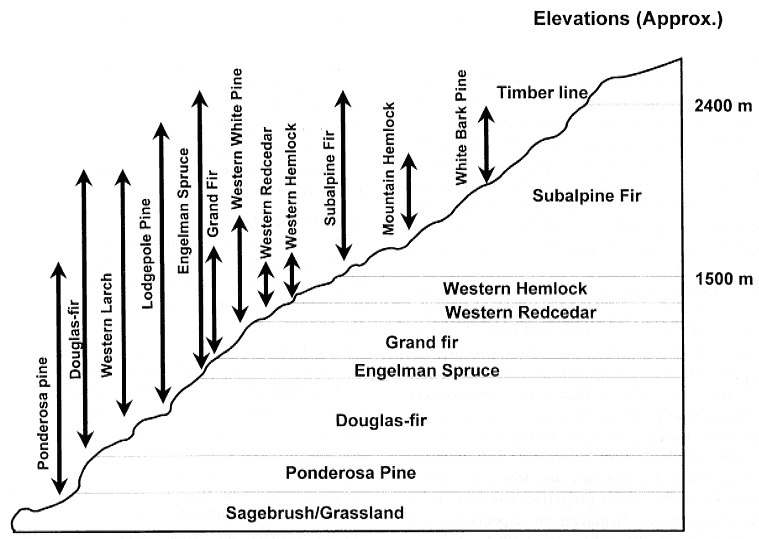
Mixed-conifer forest types dominate forests of the Inland Northwest, and comprise part of the Columbia Forest and Rocky Mountain ecoregions (Bailey 1980). These forests are highly variable, ranging from coastal to semi-arid conditions (Figure 1). The dry sites are characterized by widely spaced ponderosa pine (Pinus ponderosa Dougl. ex Laws.) or Douglas-fir [Pseudostuga menziesii (Mirb.) Franco] forests, intermixed with grasses (Calamagrostis spp.) and low shrubs (Symphorocarpus spp.) in the understory. These forests are often located in the rain shadow of major mountain ranges, such as the Bitterroots in Montana and the Cascades in Washington and Oregon. Because of many decades of fire suppression, large numbers of ponderosa pine and Douglas-fir seedlings and saplings are presently found on many of these sites. Down logs and coarse woody debris are abundant, but historically much of this material was consumed by frequent fires (Habeck and Mutch 1973, Arno 1980).
Douglas-fir or grand fir [Abies grandis (Dougl. ex D. Don) Lindl.] forests occur in more mesic conditions, typically at elevations above dry Douglas-fir and climax ponderosa pine ecotypes. Species composition includes an admixture of these two species with lodgepole pine (Pinus contorta Dougl. ex Loud.), and western larch (Larix occidentalis Nutt.). In northern Idaho western white pine (Pinus monticola Dougl. ex D. Don.) is often a principal associate on moist sites. The understory is characterized by grasses (e.g. Calamagrostis spp.), forbs [e.g. Clintonia uniflora (Schult.) Kunth.], low shrubs (e.g. Vaccinium spp.) and tall shrubs (e.g. Ceanothus spp., Physocarpus spp., Alnus spp., Acer spp.). Because these forests are productive, they accumulate large amounts of coarse woody debris, and tend to be densely stocked (Brown and See 1981, Graham 1988). Historically, ponderosa pine, western larch, and Douglas-fir dominated most stands, especially on drier sites, while western white pine was important on moist sites (Habeck and Mutch 1973). The exclusion of fire and the introduction of white pine blister rust (Cronartium ribicola J.C. Fisch.) in these forests has caused an invasion of shade-tolerant species, such as grand fir. These changes in stand composition and structure make these forests more susceptible to insect and disease attack, and to fires (Agee 1993, Hessburg et al. 1994).
Figure 1—Generalized distribution of forest trees in the Inland Northwest. Horizontal bars indicate the major forest habitat type series found in the region with the vertical arrows indicating the relative elevation range of the species found in the habitat types (Pfister et al. 1977, Arno 1979, Steele et al. 1983, Cooper et al. 1991). [view larger image - 32K]
Mixed western redcedar (Thuja plicata Donn ex D. Don), western hemlock [Tsuga heterophylla (Raf.) Sarg.], grand fir, and Douglas-fir forests dominate parts of northern Idaho, western Montana, and eastern Washington. These forests are the most productive in the Inland Northwest. They are characterized by high amounts of precipitation (1300 mm yr-1) and fertile volcanic ash soils (Graham 1990, Cooper et al. 1991). Before the occurrence of white pine blister rust, large expanses of western white pine covered much of this region, but now it is usually a minor stand component. The understory vegetation in closed canopy forests consists primarily of forbs (e.g. Clintonia spp., Smilacina spp., and Pyrola spp.). In openings, low shrubs such as huckleberry (Vaccinium spp.) and gooseberry (Ribes spp.), and tall shrubs such as alder (Alnus spp.) and Rocky Mountain maple (Acer glabrum Torr.) can occur. Large accumulations of coarse woody debris are common, especially where western white pine mortality from blister rust has been high (Brown and See 1981, Harvey et al. 1989c, Reinhardt et al. 1991).
The Engelmann spruce (Picea engelmannii Parry ex Engelm.)/subalpine fir [Abies lasiocarpa (Hook.) Nutt.] zone lies at elevations above the mixed fir forests and western redcedar-western hemlock forests (Steele et al. 1981, 1983, Cooper et al. 1991). This zone is characterized by Douglas-fir, western larch, and lodgepole pine in seral stages, and Engelmann spruce and subalpine fir in later stages of succession (Pfister et al. 1977, Cooper et al. 1991). Slow decomposition rates and long fire intervals (100 to 400 years) in these forests cause large accumulations of coarse woody debris (Brown and See 1981). The understory is usually dominated by medium (Vaccinium spp.) and tall (Menziesia ferruginea Smith) shrubs.
On the east slopes of the Rocky and Cascade Mountains, and on many subalpine fir habitat types, lodgepole pine can be perpetuated by fire (Pfister et al. 1977). Dense, stagnated stands of pure lodgepole pine often develop, which are prone to bark beetle (Dendroctonus spp. and Ips spp.) attack and large stand-replacing fires. These sites are characterized by short growing seasons and cold temperatures. The amounts of coarse woody debris varies considerably and depends on stand fire history. Low shrubs (Vaccinium spp.) and grasses (Calamagrostis spp.) usually dominate the understory.
The subalpine forest types dominated by white bark pine (Pinus albicaulus Engelm.), mountain hemlock [Tsuga mertensiana (Bong.) Carr.] and subalpine fir are found at the highest elevations of the region. Trees in these forests are often widely spaced and have an understory of bear grass [Xerophyllum tenax (Pursh.) Nutt.], low shrubs (Vaccinium spp.), and sedges (Carex spp.). Cold temperatures and the short growing season limit forest productivity. These forests generally have little accumulation of coarse woody debris (Brown and See 1981).
Inland Northwest forests occupy a vast area of the western United States in which erosional processes, active volcanism, and weathering regimes have interacted to produce a diverse landscape. The resulting forest soils are equally diverse and have generally developed from three types of parent materials: (1) volcanic ash (including pumice), (2) glacial deposits, and (3) weathered bedrock. Nine of the eleven soil orders are present with Inceptisols, Alfisols, and Andisols being the most abundant (Geist and Cochran 1991, Meurisse et al. 1991, Harvey et al. 1994).
Extensive areas of soils with volcanic ash caps are found on a variety of parent materials, ranging from loess deposits and glacial tills to granitic and schist bedrock. Pumice soils predominate in northwestern California and central Oregon, whereas ash cap soils are most common in eastern Washington, northern Idaho, and northwestern Montana. Thickest ash caps occur on north-facing slopes where soil erosion has been the least. Soils developed from these volcanic deposits have relatively high inherent productivities, low bulk densities, and few coarse fragments (Geist et al. 1989). These properties also make them susceptible to mechanical displacement, especially when soil moisture is low (Geist and Cochran 1991). Ash and pumice soils are usually well drained with moderate to high infiltration rates and water holding capacities. However, once disturbed, damage to ash soils by compaction to depths of 30 cm can last for decades (Froehlich et al. 1985). Other site disturbances, such as ash displacement, remove nutrients, lower water-holding capacity, and also reduce site productivity (Geist and Cochran 1991).
Continental and alpine glaciers deposited various sized tills and outwash materials in northern Washington, Idaho, and Montana during the Pleistocene (Meurisse et al. 1991). Volcanic ash later covered many of these deposits. The soil material below the ash cap usually has a high percentage of rock fragments, and a low moisture and nutrient-holding capacity. If the ash cap is reduced, compacted or removed, the productive capacity of the soil is significantly lowered (Cochran and Brock 1985).
Soils formed from weathered granite, gneiss, and schist bedrock are located primarily in southern Idaho and eastern Oregon. These skeletal soils are mostly Inceptisols and Alfisols. Low summer precipitation in these regions, coupled with low soil water and nutrient-holding capacities, generally limit tree growth on these soils (Childs 1982, Clayton and Kennedy 1985).
The type and distribution of soil organic matter in Inland Northwest forests is variable and depends on stand age and location, tree species, and fire history. Large amounts of soil organic matter are found in surface organic layers (forest floor and woody residue) of old-growth soils, except in the fire-dominated lodgepole and ponderosa pine ecosystems (Table 1). Each of these soil organic components has a unique chemical and physical character based on the type of organic material present and the nature of underlying mineral soil (Quesnal and Lavkulich 1981, Prescott et al. 1989). Surface mineral horizons (< 30 cm deep) also contain large amounts of organic matter, especially if the soil has a significant volcanic ash content (Page-Dumroese et al. 1991, Harvey et al. 1994). Surface soil is the zone of greatest importance for site productivity, since root numbers, and presumably root activity, decrease rapidly below this depth (Kimmins and Hawkes 1978, Vogt et al. 1981, Strong and La Roi 1985, Little and Shainsky 1992). It is also the part of the soil most likely to be disrupted or destroyed by forest management activities. Considerable organic matter can also be found in deeper soil horizons, which can be very important to soil productivity on certain sites (Henderson 1995).
| Cedar/ hemlock Idaho |
Cedar/ hemlock Montana |
Subalpine fir Montana |
Douglas-fir Montana |
Ponderosa pine Montana |
Lodgepole pine Wyoming |
Lodgepole pine Oregon |
|
|---|---|---|---|---|---|---|---|
| 1Values are from one stand in each of the forest cover types. Taken from Fahey (1983), Page-Dumroese et al. (1991), Busse 1994, J.B. Yavitt, unpublished data. 2Woody residue > 7.6 cm in diameter, except for lodgepole pine (Wyoming) where all down dead wood was measured. 3To a depth of 30 cm. These values do not include root weights. |
|||||||
| Organic matter (Mg ha−1) | |||||||
| Woody residue2 | 154 | 83 | 146 | 45 | <2 | 2 | 38 |
| Forest floor | 71 | 101 | 72 | 63 | 9 | 24 | 18 |
| Mineral soil3 | 201 | 145 | 153 | 133 | 160 | 162 | 52 |
| Total | 426 | 329 | 371 | 241 | <189 | 188 | 108 |
| Nitrogen (kg ha−1) | |||||||
| Woody residue | 231 | 125 | 219 | 68 | <30 | 2 | 40 |
| Forest floor | 476 | 1,128 | 914 | 857 | 161 | 358 | 174 |
| Mineral soil | 3,045 | 1,729 | 1,686 | 2,183 | 3,433 | 4,030 | 1,152 |
| Total | 3,752 | 2,982 | 2,819 | 3,108 | <3,624 | 4,390 | 1,366 |
Total organic contents of Inland Northwest forest soils generally reflect site productivity and climate. Forest productivity is greatest in warm, moist cedar and hemlock habitat types in northern Idaho, and lowest on dry Douglas-fir and ponderosa pine sites (Table 1). Subalpine fir habitat types also have high soil organic matter contents, but productivity is generally lower than cedar and hemlock sites (Pfister et al. 1977, Steele et al. 1981, Cooper et al. 1991). Low temperatures on these higher elevation habitat types probably limit both organic matter decomposition and tree growth. Site productivity is generally low on Douglas-fir and ponderosa pine sites, but organic levels in surface mineral layers may be quite high beneath certain grass communities (Nimlos and Tomer 1982).
While soil organic matter/productivity relationships are readily apparent among tree species, this relationship is much less evident when applied to a single species over a large area. Poor correlations of soil organic matter content with height growth have been reported for Douglas-fir and western hemlock in western Washington and Oregon (Edmonds and Chappell 1994), and for Douglas-fir in Idaho and western Montana (Monserud et al. 1990). Soil organic matter/tree growth responses would also be confounded by other site factors, especially precipitation and evapotranspiration . The large variability of soil organic matter content in response to individual site differences, such as slope, parent material, and soil depth, also make regional organic matter/productivity extrapolations difficult.
Woody residue can be any size, but material larger than 7.5 cm in diameter has the potential to become a long-term component of soil ecosystems. Wood less than 7.5 cm in diameter usually decays quite rapidly or burns readily in both prescribed or wildfires (Edmonds 1991, Reinhardt et al. 1991). Studies have shown that woody material can have important roles in tree seedling establishment, soil carbon cycling, nutrient and water storage, and animal activity (Sollins et al. 1980, 1987, Harmon 1987, Amaranthus et al. 1989, Arthur and Fahey 1992, Harmon et al. 1994, Tallmon and Mills 1994). Woody residue in many Inland Northwest forests may equal or exceed organic matter contents in the forest floor (Brown and See 1981). Generally, the levels of woody residue in undisturbed stands increases with stand age, as site moisture conditions improve, and as fire hazard decreases (Spies et al. 1988, Harcombe et al. 1990).
Woody residue decay is primarily a function of invertebrate activity, the colonization of wood by white-rot and brown-rot fungi, and soil surface microclimate (Larsen et al. 1980, Swift and Boddy 1984, Harmon et al. 1986, Edmonds 1991). As wood decay progresses, water and N content generally increase (Jurgensen et al. 1984, Harmon et al. 1986). Initial sapwood decay frequently is of the white-rot type, which eventually shifts to brown-rot. Heartwood of down-woody residue is usually decayed by brown-rot fungi. Typically, brown-rot fungi remove cellulose and modify lignin, while white-rot fungi remove similar amounts of both cellulose and lignin. However, the rates at which these materials are decomposed vary with fungal species (Setliff and Eudy 1979, Boddy 1991). Brown-rot fungi largely control the decay patterns of large woody residue in the Inland Northwest (Larsen et al. 1980).
When decayed woody residues become incorporated into the forest floor or mineral soil, they can be termed soil wood. This advanced decayed wood is also called class IV and V logs in coarse, woody debris classification systems used in Washington and Oregon (Eubanks 1989). At this stage the wood often is covered by litter and not noticed as a soil component. Soil wood can comprise over 50% of the surface soil organic matter in old-growth stands of the Inland Northwest (Page-Dumroese et al. 1991). A large soil wood component has also been reported on sites in Oregon, Washington, and western Canada (Little and Ohmann 1988, Prescott et al. 1989). In some stands this accumulation is so pronounced that a separate forest floor designation (Lignomor) has been established (Green et al. 1993). The amount of soil wood present on a site generally increases as overall forest productivity increases. Soil wood retains more moisture than the forest floor during dry summer months, and can be quite resistant to destruction by fire, especially on highly productive hemlock sites (Page-Dumroese et al. 1991, Reinhardt et al. 1991, 1994).
Virtually all of the soil wood in Inland Northwest forests is a product of brown-rot decay, and come from large residues with appreciable amounts of heartwood, especially pine species and Douglas-fir (Harvey et al. 1987a). Brown-rotted wood remains in the soil for hundreds of years (McFee and Stone 1966, Harvey et al. 1981), thus affecting soil properties for long periods. In contrast, white-rotted soil wood, originating from conifer sapwood or hardwood sapwood/ heartwood, rapidly loses its structural integrity once it becomes part of the forest floor. However, it has a lower extractive content, a higher potential for nonsymbiotic N fixation, and more rapid nutrient fluxes than brown-rotted wood (Larsen et al. 1980, Harmon et al. 1986, Jurgensen et al. 1989).
Timber harvesting and subsequent site preparation techniques can have a major impact on soil properties and productivity. Historically, clearcutting followed by burning or mechanical site preparation (e.g. soil scarification, scalping) has been favored in the Pacific Northwest to manage for early sucessional species, such as Douglas-fir or western larch (Graham et al. 1989a, Ferguson and Carlson 1991, Arno and Fischer 1995). Site preparation can improve early seedling growth and survival on many sites in this region where competition from other plants is high (Ross et al. 1986, Thomson and McMinn 1989, Packee 1990, Messier et al. 1995). However, these treatments, which are often accompanied by soil organic matter losses, soil compaction, and surface mineral soil displacement, can also reduce tree growth (Atzet et al. 1989, Powers 1991). The degree of soil disturbance will vary according to: (1) intensity of site treatment, (2) type of equipment used, (3) time of year harvesting occurs, and (4) amount of organic matter on the soil surface (Ross and Walsted 1986, Minore and Weatherly 1988, Clayton 1990, Graham et al. 1991b, Page-Dumroese 1993). Soils having higher amounts of organic matter in forest floor and soil wood would be more affected by these disturbances than soils having higher organic contents in suface mineral layers.
| Site treatment | Soil properties | Seedling characteristics | ||||||
|---|---|---|---|---|---|---|---|---|
| Bulk density (mg m−3) |
Organic matter (kg kg−1) |
Total N (g kg−1) |
Available N (mg kg−1) |
Height (cm) |
Root depth (cm) |
Total weight (g) |
Competing vegetation2 (kg ha−1) |
|
| 1Values from Page-Dumroese et al. (1997). 2Values from Graham et al. (1989a). 3Herbicide applied–1.7 kg ha−1 glyphosate. |
||||||||
| Grand fir habitat type | ||||||||
| Mounded | 0.70 | 0.17 | 2.9 | 62 | 26 | 28 | 7 | 9,192 |
| Mounded-herbicide3 | 0.68 | 0.17 | 3.0 | 58 | 39 | 34 | 26 | 280 |
| Scalped | 0.92 | 0.08 | 1.3 | 18 | 32 | 22 | 15 | 684 |
| None | 0.76 | 0.12 | 2.6 | 32 | 36 | 24 | 10 | 3,760 |
| Western hemlock habitat type | ||||||||
| Mounded | 0.58 | 0.24 | 2.8 | 37 | 31 | 21 | 12 | 1,711 |
| Mounded-herbicide | 0.58 | 0.18 | 2.8 | 52 | 29 | 29 | 13 | <50 |
| Scalped | 0.85 | 0.11 | 1.5 | 19 | 24 | 20 | 8 | <50 |
| None | 0.65 | 0.27 | 2.2 | 66 | 28 | 21 | 8 | <50 |
| Species/treatment | Age2 | Survival (%) |
Height (cm) |
Diameter (cm) |
Plantation growth index3 | |
|---|---|---|---|---|---|---|
| (Index) | (T/C4) | |||||
| 1Values from Boyd (1986). Herbicide data shown for Velpar. If different rates, formulations, or method of application used, results were averaged. 2Number of growing seasons since planting. 3Plantation Growth Index is the product of survival, mean height, and mean diameter2—a value proportional to the amount of stemwood produced/100 planted trees. 4T/C = the ratio of site treatment to control. |
||||||
| Montana – Ponderosa pine | ||||||
| Control | 6 | 31 | 64.7 | 13.2 | 3,453 | — |
| Scalping | 6 | 60 | 65.1 | 14.1 | 7,786 | 2.2 |
| Herbicide | 6 | 83 | 97.8 | 23.0 | 50,631 | 14.7 |
| Montana – Lodgepole pine | ||||||
| Control | 6 | 31 | 53.7 | 9.4 | 1,526 | — |
| Scalping | 6 | 72 | 58.2 | 11.5 | 7,553 | 5.0 |
| Herbicide | 6 | 75 | 78.1 | 16.1 | 15,025 | 9.8 |
| Washington – Douglas-fir | ||||||
| Control | 3 | 75 | 34.2 | 5.2 | 813 | — |
| Scalping | 3 | 74 | 31.1 | 5.3 | 1,143 | 1.4 |
| Herbicide | 3 | 78 | 44.1 | 7.5 | 2,010 | 2.5 |
| Idaho – Douglas-fir | ||||||
| Control | 6 | 46 | 52.9 | 7.7 | 1,463 | — |
| Scalping | 6 | 74 | 64.7 | 11.5 | 7,704 | 5.3 |
| Herbicide | 6 | 46 | 66.7 | 11.6 | 4,111 | 2.8 |
| Idaho – Lodgepole pine | ||||||
| Control | 6 | 27 | 84.2 | 13.9 | 4,627 | — |
| Scalping | 6 | 83 | 118.6 | 24.8 | 79,852 | 17.3 |
| Herbicide | 6 | 31 | 100.5 | 16 | 10,950 | 2.4 |
Site preparation methods that increase organic matter content in surface soil layers (e.g. mounding or bedding) improve soil physical and chemical properties, and can result in greater seedling growth (Table 2, Sutton 1993). In contrast, site treatments that compact the soil and significantly lower surface soil organic and nutrient levels, such as scalping, can have negative impacts on seedling development. Scalping is a common method of site preparation in the Inland Northwest, and can benefit seedling establishment and growth by eliminating competing vegetation from the planting site and raising soil temperature on cold sites (Table 3, Sutton 1985, Thomson and McMinn 1989, McNabb et al. 1993, Fleming et al. 1994, Powers 1996). However, as shown in Table 2 and in other studies (Miller and Breuer 1984, Graham et al. 1989a), scalping can sometimes have little benefit and occasionally reduces tree growth. An alternative site treatment to scalping is the application of herbicides, which reduce competition but maintains surface organic matter layers intact. In many instances, seedlings grow better after herbicide treatment when compared to scalping or grubbing (Table 3). These positive growth responses to herbicides occur even when plant competition is equal to, or greater than scalped treatments. Consequently, scalping should only be used on sites where environmental concerns restrict herbicide application, or mineral soil is required for seed germination.
A key issue of site preparation effects on soil properties is the length of time such treatments impact site productivity. Several studies have shown that tree growth is influenced by site preparation to at least the sapling stage (Cole and Schmidt 1986, Clayton et al. 1987, Graham et al. 1989a). One method to estimate site preparation effects on future tree development is to use a stand projection model such as PROGNOSIS (Wykoff et al. 1982). By using height increment and physical site informaton, this model estimates the impacts of site treatments on long-term productivity. A short-term scenario assumes that early growth responses to site preparation have stopped when the trees reach a diameter of 7.5–12.5 cm, while a long-term response assumes growth differences continue throughout a rotation (100 years). Using the more conservative stand projection (short-term effects), scalping reduced total volume of western larch on two sites by 4–6% (Table 4). If a long-term response is assumed, scalping caused a 20–27% reduction in volume. In contrast, if soil is mounded and competing vegetation is controlled, a 5–12% increase is projected for the short-term. If these site preparation benefits are extended over the 100 year life of the stand, a 63–70% increased yield is projected. Similar results were found with Douglas-fir (Graham et al. 1991a). While other sites and stands may react differently, the potential impact of differing site preparation techniques on final tree volume is apparent.
Short-term losses of organic matter (1 to 5 years) after clearcutting and site preparation have been determined by measuring woody residue and soil organic matter levels before and after harvest, or on adjacent cut and uncut stands. Results from these studies indicated organic matter losses from woody residues and the forest floor in western conifer forests ranged from 2 to over 150 Mg ha−1, with higher losses found after prescribed burns (Cromack et al. 1979, DeByle, 1980, Feller 1988, Reinhardt et al. 1991, Johnson 1992). Harvesting operations also incorporate forest floor material and harvest residues into the mineral soil, which can increase organic content in the surface soil for the first few years after harvest (Packer and Williams 1976, Cromack et al. 1979). However, these higher levels of organic matter in the mineral soil generally decrease as the new stand develops (Kraemer and Hermann 1979, Durgin 1980).
| Site treatment4 | Short-term calibration2 | Long-term calibration3 | |||||
|---|---|---|---|---|---|---|---|
| Seedling ht5 (cm) |
Mean diam (cm) |
Mean ht (m) |
Total vol (mg3 ha−1) |
Mean diam (cm) |
Mean ht (m) |
Total vol (mg3 ha−1) |
|
| 1Values from Graham et al. (1995). 2The growth rate established by the 5 yr height increment attenuated to the average growth rate for the site by the time the trees reach 7.6 cm to 12.7 cm in diameter. 3The growth rate established by the 5 yr height increment is maintained for the 100 yr. 4Site preparations described by Page-Dumroese et al. (1997). 5Seedling height at the end of eight growing seasons after planting. |
|||||||
| Grand fir habitat type | |||||||
| Mounded | 162 | 30.7 | 35.1 | 203 | 30.7 | 37.8 | 203 |
| Mounded-herbicide | 201 | 33.3 | 37.2 | 262 | 42.2 | 35.1 | 525 |
| Scalped | 113 | 31.5 | 34.8 | 224 | 32.0 | 36.0 | 235 |
| None | 140 | 32.5 | 34.4 | 233 | 35.8 | 40.5 | 323 |
| Grand fir habitat type | |||||||
| Mounded | 128 | 36.8 | 52.4 | 326 | 38.4 | 40.2 | 384 |
| Mounded-herbicide | 192 | 36.6 | 41.2 | 325 | 40.1 | 41.5 | 433 |
| Scalped | 107 | 35.6 | 37.5 | 289 | 31.5 | 37.5 | 201 |
| None | 128 | 36.6 | 38.4 | 309 | 34.0 | 38.7 | 254 |
Longer-term organic matter changes following harvest can be evaluated by comparing soil organic content in stands having different ages since cutting. Because preharvest soil conditions usually are not known, sites of similar stand history, species composition, topography, etc. are selected to limit the inherent variability in organic matter contents among soils. Unfortunately, only a few studies of this type have been conducted in western forests. Clayton and Kennedy (1985) estimated that it may take more than 50 years to restore soil organic matter and nutrients to previous levels in disturbed forest ecosystems in central Idaho. Results from less controlled studies in the Inland Northwest also indicate reductions in the thickness of surface organic layers for a considerable time after harvesting or fire (Harvey et al. 1986). Most of this information was obtained from sites which were clearcut and had fairly intensive site preparation. However, the current emphasis on ecosystem management in western forests will likely reduce the use of these silvicultural practices in the future (O'Hara et al. 1994), thus aleviating some detrimental soil impacts associated with timber harvesting.
Losses of organic matter from the forest floor and mineral soil following timber harvesting are generally a result of increased organic matter decomposition by soil microorganisms (Hendrickson et al. 1982). Increased soil moisture, temperature, and alkalinity after harvesting, especially if fire is used for slash disposal, favors increased microbial activity (Hungerford 1980, Jurgensen et al. 1981, 1982). Mechanical site preparation mixes the forest floor into mineral soil, which generally increases organic matter decomposition rates (Salonius 1983), and improves the growth of subsequent regeneration (Graham et al. 1989a, Thomson and McMinn 1989). However, on some sites with thick H horizons, soil mixing can reduce microbial activity and organic matter decomposition (Messier et al. 1995).
Considerable interest has developed on leaving adequate amounts of woody residue after timber harvesting. It is generally recognized that some wood should be left on site to increase biodiversity, and this may also be important for long- term site productivity (Heilman 1990, Swanson and Franklin 1992). However, the optimal amount of woody residue to leave will depend on habitat type, fire hazard, regeneration method, and pre-harvest soil organic matter levels. The site preparation method used will also be a major factor (see Table 7). A minimum of 22 to 36 Mg ha−1 of residual woody material has been recommended for moist habitat types of northwestern Montana and northern Idaho (Harvey et al. 1987a). Leaving greater amounts of woody residue may further benefit stand productivity on many sites, but may also increase fire risk. After considering fire hazard and other site preparation objectives, Reinhardt et al. (1991) established a fairly wide range of allowable woody residue loadings (22–125 Mg ha−1) for mixed conifer forests in the northern Rocky Mountains. However, on some of the drier sites in the region (e.g. ponderosa pine, lodgepole pine, and Douglas-fir), leaving residue loadings of less than 10 Mg ha−1 may be adequate to maintain soil organic matter levels (Graham et al. 1994).
How much organic matter to leave on a site after harvesting will also be influenced by whether the new stand is to be established by planting or by relying on natural regeneration. The removal of large amounts of surface organic matter by machine piling, windrowing, or prescribed burning to expose mineral soil is desireable when establishing regeneration from seed, especially western larch and ponderosa pine (Haase 1986, Shearer and Stickney 1991). However, seedbed preparation runs the risk of depleting soil organic matter reserves needed for subsequent seedling growth and development (Graham et al. 1989b, Minore and Weatherley 1990, Miller 1991). Such extensive soil disturbance and organic matter removals are normally not required if a site is planted with nursery stock (Harvey et al. 1987b).
Nitrogen is required for tree growth in greater amounts than any other mineral nutrient, and is usually the nutrient most limiting in western forest soils (Binkley 1991, Miller et al. 1991, Moore et al. 1994). Since nearly all soil N in forest soils is present as organic forms, soil N content in Inland Northwest soils generally parallels that of soil organic matter (Table 1). Consequently, logging operations in western forests that result in large organic matter losses also remove considerable soil N (Cromack et al. 1979, Stark 1979, Jurgensen et al. 1981, Feller and Kimmins 1984). Increased residue removal, shorter stand rotation age, and total tree harvesting may further increase N losses (Wollum and Davey 1975, Jurgensen et al. 1980). If prescribed fire is also used as a site preparation tool, soil N losses can exceed 500 kg ha−1 (Feller 1988, Little and Ohmann 1988). Nitrogen lost in fires is directly proportional to the amount of organic matter consumed and temperatures produced (Mroz et al. 1980, Hungerford et al. 1991). The significance of such N depletion to site productivity depends on total N capital present in the soil and the magnitude of N losses, especially from surface organic layers (Jurgensen et al. 1980, Edmonds and Bigger 1984).
Replacement of soil N lost from timber harvesting or fire would come from precipitation and dry deposition (dust, pollen, etc.), biological nitrogen fixation, and forest fertilization. Nitrogen fertilizer applications are economically feasible on many sites in the Inland Northwest (Moore et al.1994) , but may increase risk of endemic root disease or animal damage in some stands (Nelson 1989, Entry et al. 1991, Miller et al. 1991). In areas with high precipitation and large urban and industrial centers, such as the northeastern U.S., atmospheric N inputs can add >20 kg N ha−1 yr−1 (Kimmins et al. 1985). However, in the relatively dry Inland Northwest with its low population density, N additions to forested sites normally average between 0.5 and 2.5 kg ha−1 yr−1 (Tiedemann et al. 1978, Clayton and Kennedy 1985, Fahey et al. 1988, NADP/NTN 1992). Nitrogen additions from biological N fixation come from two sources: (1) microorganisms living in specialized nodules on plant roots (symbiotic N-fixation), and (2) free-living soil microorganisms (nonsymbiotic N-fixation). The contribution of each varies considerably depending on site location, elevation, soil type, stand seral stage, and cover type. Most of the estimates of N fixation in western forests were obtained using the acetylene reduction technique (Silvester, 1983). While many questions have been raised about the suitability of this technique, it does give a relative measure of N- fixing potential among various ecosystems and site treatments.
| Pinus flexilis (58)2 (%)3 |
Pinus ponderosa (180) (%) |
Pseudo tsuga (1,124) (%) |
Abies grandis (411) (%) |
Thuja (311) (%) |
Tsuga hetero phylla (189) (%) |
Picea (219) (%) |
Tsuga merten siana (103) (%) |
Abies lasio carpa (1,645) (%) |
Pinus albicaulis (53) (%) |
|
|---|---|---|---|---|---|---|---|---|---|---|
| 1Data are from late seral and climax forest stands (Pfister et al. 1977, Steele et al. 1981, 1983, Cooper et al. 1991). 2Total number of stands examined within each habitat series. 3Percent of stands in which genus found. |
||||||||||
| Nonlegumes | ||||||||||
| Alnus | 0 | 0 | 9 | 4 | 4 | 4 | 10 | 3 | 8 | 0 |
| Ceanothus | 3 | 9 | 11 | 10 | 4 | 2 | 0 | 0 | 1 | 0 |
| Cercocarpus | 5 | 2 | 3 | 0 | 0 | 0 | 0 | 0 | 0 | 0 |
| Purshia | 7 | 31 | 8 | <1 | 0 | 0 | 0 | 0 | <1 | 6 |
| Shepherdia | 19 | 6 | 14 | 4 | 1 | 5 | 35 | 0 | 17 | 23 |
| Legumes | ||||||||||
| Astragalus | 53 | 16 | 19 | 4 | 3 | 0 | 22 | 0 | 7 | 28 |
| Hedysarum | 21 | 5 | 4 | <1 | <1 | 0 | 11 | 2 | 5 | 7 |
| Lathyrus | 0 | 8 | 2 | 10 | 6 | <1 | 3 | 0 | 1 | 0 |
| Lotus | 0 | 4 | 0 | 0 | 0 | 0 | 0 | 0 | 0 | 0 |
| Lupinus | 12 | 41 | 24 | 5 | 1 | 2 | 9 | 2 | 18 | 23 |
| Oxytropis | 7 | 2 | <1 | 0 | 0 | 0 | 0 | 0 | 0 | 2 |
| Thermopsis | 0 | 1 | <1 | 13 | 9 | 0 | 0 | 2 | 1 | 0 |
| Trifolium | 0 | 5 | 2 | 6 | 3 | <1 | 3 | 0 | 2 | 2 |
| Vicia | 2 | 17 | 4 | 6 | 4 | 2 | 5 | 0 | 1 | 0 |
Nitrogen-fixing plants in forests of the Inland Northwest can be grouped into two major categories: (1) plants in the family Leguminosae—nine genera, and (2) non-leguminous plants—five genera from four families (Table 5). The distribution patterns of these plants generally reflect soil moisture/temperature conditions and stand successional stage. Legumes are more widely distributed than non-leguminous N-fixing plants in older stands throughout the region. Lupinus spp. is the most common N-fixing genus across all habitat types, while buffaloberry [Shepherdia canadensis (L.) Nutt.] is the most frequently occurring non-leguminous N-fixing plant. Bitterbrush [Purshia tridentata (Pursh. DC.] is restricted to the drier sites, while Alnus spp. is found in cooler, wetter stands. Ceanothus spp. shows only a scattered distribution in these older stands. Ponderosa pine and Douglas-fir sites have the greatest occurrence of N-fixing plants, which likely reflects their more open stand structure.
Although species of at least one N-fixing plant occurred in all but six of the 115 habitat types examined in Montana, Idaho and Wyoming, these plants are not major understory components in most older Inland Northwest forests. Even when several N-fixing plants are found on the same site, the combined coverage of these species rarely exceeds 10% (Jurgensen et al. 1979). In contrast, early seral forests resulting from timber harvesting or fire usually have greater understory development and higher N-fixing plant frequencies than older stands (Bormann and Gordon 1989).
Most ecological studies on N-fixing plants have been very site specific, and usually detail early successional development after a disturbance, such as timber harvesting or fire. Ceanothus spp. has received particular attention, since it often becomes abundant after prescribed burns or wildfires. Ceanothus spp. seed, which can remain viable in the soil for up to 200 years, requires a heat treatment to break dormancy (Noste and Bushey 1987). Reports of Ceanothus spp. percent coverages on burned sites in Idaho and Montana have ranged from less than 5% to over 80% (Jurgensen et al. 1991). Generally the hotter the burn, the greater the development of Ceanothus spp. (Orme and Leege 1976, Noste and Bushey 1987).
The occurrence of several other N-fixing plants also increase after site disturbance. Trifolium spp. has been found on disturbed and burned sites in northern Idaho (Mueggler 1965, Stickney 1986) and Hedysarum spp. responded strongly to burning and mechanical site preparation on two habitat types in western Montana (Arno et al. 1985). Alnus spp. was either more or less common after timber harvesting or fire in various habitat types of Idaho and Montana (Mueggler 1965, Wittinger et al. 1977, Stickney 1980, 1986). Conflicting results have also been reported for Lupinus spp. and Astragalus spp. (Zamora 1975, Lyon and Stickney 1976, Arno et al. 1985, Stickney 1986, Steele and Geier-Hayes 1987, 1989, Brown and DeByle 1989). In contrast, coverage of both Purshia sp. and Shepherdia sp. was reduced after fire (Wagstaff 1980, Brown and DeByle 1989). The scattered and incomplete nature of these studies indicates that much more information is needed on the successional roles of N-fixing plants in this region.
Little information is available on the actual contribution of N-fixing plants to the N economy of Inland Northwest forests after harvesting. Studies on moist, highly productive sites in western Oregon and Washington have reported additions over 100 kg of N ha−1 yr−1 from Ceanothus spp. and Alnus spp. (Conard et al. 1985, Hibbs and Cromack 1990, Binkley et al. 1992). Nitrogen gains from N-fixing plants are likely lower on the generally drier sites in the Inland Northwest. Estimated N fixation by snowbrush (Ceanothus velutinus Dougl. ex Hook.) in central Oregon ponderosa pine stands range from 7 to 72 kg N ha−1 yr−1, depending on stand age and snowbrush coverage (Youngberg and Wollum 1976, McNabb et al. 1979, Busse 1992). In contrast, Hendrickson and Burgess (1989) reported that Lupinus spp. and Shepherdia sp. added only 2.8 kg N ha−1 yr−1 to a cut-over lodgepole pine site in southern British Columbia. Other estimates of N fixation by Lupinus spp. range from 0.1 kg N ha−1 yr−1 in older, southeastern Wyoming lodgepole pine stands (Fahey et al. 1985) to 0.6 kg N ha−1 yr−1 in Utah aspen stands (Skujins et al. 1987). Nitrogen additions from Purshia sp. in ponderosa and lodgepole pine stands of central Oregon can vary from less than 0.1 kg N ha−1 yr−1 to 8 kg N ha−1 yr−1 (Dalton and Zobel 1977, Busse 1992).
| Subalpine fir (Montana) |
Cedar/hemlock (Montana) |
Douglas-fir (Montana) |
Cedar/hemlock (Idaho) |
|||||||
|---|---|---|---|---|---|---|---|---|---|---|
| 1Values from Jurgensen et al. (1991). 2Total N fixed/ha over a 180 day period in 1977 as measured by the acetylene reduction technique using a 3:1 ethylene to N conversion ratio. 3Percentage of total soil N fixed in that soil component. 4Mineral soil sampled to a depth of 30 cm. |
||||||||||
| Soil component | (g N) | (%N fix) | (g N) | (%N fix) | (g N) | (%N fix) | (g N) | (%N fix) | ||
| Wood residue | 5152 | 353 | 230 | 27 | 159 | 20 | 1,428 | 49 | ||
| Forest floor | 328 | 22 | 192 | 23 | 101 | 13 | 88 | 4 | ||
| Soil wood | 250 | 17 | 91 | 11 | 95 | 12 | 178 | 6 | ||
| Mineral soil4 | 379 | 26 | 326 | 39 | 442 | 55 | 1,197 | 41 | ||
| Total | 1,472 | 839 | 797 | 2,891 | ||||||
There has been worldwide interest in artifically establishing N-fixing plants after harvesting, especially under intensive plantation management, or after fire (Turvey and Smethurst 1983). Several studies on seeding N-fixing legumes on cut and burned sites have been conducted in the Inland Northwest (Everett et al. 1991, Trowbridge and Holl 1992). Early results have been encouraging. On some dry sites, N-fixing plants may enhance natural regeneration by providing shade during the critical seed germination and seedling establishment period (Geier-Hayes 1994, Jones 1995). However, on many other sites N-fixing plant competition for light and water may outweigh possible N benefits to tree seedlings (Stewart et al. 1984, Petersen et al. 1988, McDonald and Fiddler 1989, Loucks and Harrington 1991). Additional studies are needed to determine the management potential for such N-fixing plant treatments.
Reports of prolific development of Ceanothus spp. in certain habitat types after timber harvesting or fire should not obscure the fact that this and other N-fixing plants are lacking or of low frequency on many harvested sites in the Inland Northwest. On these sites, the replacement of N losses due to timber removal would have to come from nonsymbiotic N fixation and atmospheric deposition. Nitrogen additions from nonsymbiotic N fixation are highest in moist northern Idaho cedar or hemlock habitat types, and lowest on dry Douglas-fir habitat types in western Montana (Table 6). Surface organic materials contributed well over half of the nonsymbiotic N fixed in these soils, except for the dry, low organic matter Douglas-fir site. Nonsymbiotic N fixation rates show considerable annual variation, which relate to yearly differences in soil temperature and moisture (Jurgensen et al. 1992).
Coarse woody residue is an especially important source of N fixation in Inland Northwest forests, and can account for up to 50% of the total N fixed (Table 6). The greater the woody residue loadings on a site, the greater the N gains from nonsymbiotic N fixation. On warm, dry sites, the accumulation of woody residue and N fixation is lower than on wetter, more productive sites. While residue weights for these stands (see Table 1) are higher than regional averages, they are nowhere near the maximum for these forest types (Jurgensen et al. 1987). Consequently, on sites with heavy residue loadings, such as in overmature stands on moist sites, gains from N fixation could be much higher.
| Clearcut — residue treatment | Uncut | |||||||||
|---|---|---|---|---|---|---|---|---|---|---|
| None | Prescribed burn | Intensive removal | Heavy slash2 | |||||||
| 1Values from Jurgensen et al. (1992). 2Residue from the intensive removal plots added to these plots. 3Dry mass ha−1 of organic material on top of mineral soil. 4Estimate of total N fixed ha−1 over a 180 day period. 5Woody residue > 7.6 cm in diameter. |
||||||||||
| Soil component | (Mg3) | (g N4) | (Mg) | (g N) | (Mg) | (g N) | (Mg) | (g N) | (Mg) | (g N) |
| Wood residue5 | 146.0 | 984 | 57.9 | 177 | 0.6 | 111 | 249.8 | 1,483 | 154.3 | 1,428 |
| Forest floor | 16.7 | 110 | 5.5 | 26 | 13.3 | 73 | 34.5 | 326 | 23.2 | 88 |
| Soil wood | 50.9 | 109 | 22.4 | 47 | 51.6 | 195 | 50.3 | 430 | 47.9 | 178 |
| Mineral soil4 | — | 1,218 | — | 826 | — | 1,125 | — | 1,608 | — | 1,197 |
| Total | 213.6 | 2,421 | 85.8 | 1,076 | 75.5 | 1,504 | 334.6 | 3,847 | 225.4 | 2,891 |
Nonsymbiotic N fixation is especially susceptible to harvesting impacts due to its dependence on adequate organic matter supplies (Jurgensen and Davey 1970, Sprent and Sprent 1990). The greater the amounts of organic matter removed or destroyed by harvesting and site treatments, the greater the reduction in N fixation. Clearcutting and subsequent prescribed burning lowered N fixation on a cedar/hemlock site in northern Idaho by 63%, compared to an adjacent uncut stand (Table 7). Clearcutting and slash removal by dozer (intensive removal) lowered N fixation by 48%, while clearcutting without any site preparation reduced N fixation by only 16%. In contrast, increasing woody residue and forest floor weights above pre-harvest conditions increased N fixation by 33%.
Clearcutting and subsequent site preparation greatly reduces the amount of woody residue on harvested old-growth sites (Table 7). The contribution of woody residues to soil N inputs after harvesting depends on both the amount and the decay stage of woody material left. Nitrogen fixation rates generally increase as wood decay progresses (Jurgensen et al. 1987, Griffiths et al. 1993). Most woody residue in old-growth stands are large decaying logs, many of which are destroyed during harvest. They are replaced by smaller amounts of less decayed wood from cut trees, which have much lower rates of N fixation (Jurgensen et al. 1992). Soil wood generally is less disturbed by harvesting and site treatments, and consequently becomes a more important site of N fixation.
While annual soil N gains from nonsymbiotic N fixation after harvesting are small, they become significant as the new stands age. For example, in northwestern Montana only 110 kg of soil N was lost by clearcutting a subalpine fir stand, followed by a low intensity prescribed fire (Jurgensen et al. 1981). Assuming an average N fixation gain of 0.6 kg N ha−1 yr−1 for this site (Jurgensen et al. 1992), and 1.5 kg N ha−1 yr−1 is added in precipitation (NADP/NTN 1992), these N losses would be replaced in 52 years. When N removed in bolewood is also included (175–200 kg N ha−1), the length of time to replace this N loss would increase to 135–150 years. In contrast, soil N loss from clearcutting and prescibed burning an old-growth cedar/hemlock site in Idaho was 640–700 kg N ha−1 (Jurgensen et al. 1991). Using an N fixation rate of 1.1 kg ha−1 yr−1 (Table 7), and 1.5 kg N ha−1 yr−1 added in precipitation, these N losses would be replaced in 250–270 years. Such a slow return to original soil N levels could have a considerable impact on subsequent stand growth.
As discussed earlier, N-fixing plants may become established in many habitat types after harvesting. If this occurred on either of the two sites discussed above, soil N losses would be replaced much more rapidly than by nonsymbiotic N fixation alone. Assuming symbiotic N fixation rates could range from a low of 3 kg N ha−1 yr−1 (Hendrickson and Burgess 1989) to a high of 72 kg N ha−1 yr−1 (Youngberg and Wollum 1976), the recovery time to preharvest soil N levels would vary from 10 to 125 years on the cedar/hemlock site, and only 4 to 60 years on the subalpine fir site. However, competition from these N-fixing plants for light and water could greatly reduce tree seedling growth response.
Other sources of N fixation not accounted for in these calculations could also add appreciable amounts of N to the soil, and reduce the time required for site recovery. Nonsymbiotic N fixation in tree stumps, cull trees left for snags after harvesting, and large dead roots can add up to 1 kg ha−1 yr−1 (Granhall and Lindberg 1980, Harvey et al. 1989b). Increased development of N-fixing algae and lichens on the soil surface after harvest can add N, but this is likely very low due to generally dry conditions in this region throughout the summer. Nitrogen-fixing bacteria are also active in the rhizosphere of developing tree seedlings and shrubs (Amaranthus et al. 1990) and in mycorrhizae (Li et al. 1992), but how much N they add to the soil is unknown.
Nearly all of the important tree species in the Inland Northwest are ectomycorrhizal, except western red cedar, which has vasicular-arbuscular mycorrhizae. Ectomycorrhizal root development is strongly related to stand productivity in many habitat types of this region (Harvey et al. 1979). Studies in old-growth stands have shown a strong relationship of ectomycorrhizal root tips with soil organic layers (Table 8). Even though surface organic matter comprised only 6 to 33% of the surface soil volume on these sites, they contained >70% of the active ectomycorrhizal root tips except for very dry ponderosa pine. Even when surface organic layers are reduced in thickness due to harvesting, silvicultural operations, or fire, ectomycorrhizae still predominate in these layers (Harvey et al. 1986).
| Stand1 | Soil volume2: Surface organic3 (%) |
Soil volume: Mineral soil (%) |
Ectomycorrhizae: Surface organic (%) |
Ectomycorrhizae: Mineral soil (%) |
|---|---|---|---|---|
| 1Stands sampled in late spring/early summer (values from Harvey et al. 1986). 2% of soil volume to a 30 cm depth. 3Forest floor and soil wood. |
||||
| Montana | ||||
| Western hemlock | 32 | 68 | 89 | 11 |
| Subalpine fir | 33 | 67 | 93 | 7 |
| Douglas-fir | 21 | 79 | 77 | 23 |
| Idaho | ||||
| Western hemlock | 17 | 83 | 80 | 20 |
| Western white pine | 17 | 83 | 93 | 7 |
| Washington | ||||
| Ponderosa pine | 14 | 86 | 16 | 84 |
| Wyoming | ||||
| Lodgepole pine | 6 | 94 | 71 | 29 |
Ectomycorrhizae show their best development in the forest floor, but brown-rotted soil wood is also a good site for root development, especially in cedar and hemlock forests (Page-Dumroese et al. 1994). Studies in other forest ecosystems have reported similar results (Bernstein 1960, Day and Duffy 1963, Knapp and Smith 1982, Geier-Hayes 1987, Webb 1988, Perala and Alm 1989). In periods of adequate moisture, the forest floor supports the highest level of ectomycorrhizae, but during dry summer conditions prevalent in this region, soil wood is the most active site (Table 9). Soil wood usually is wetter and cooler than the surrounding forest floor, and is affected less by daily or seasonal moisture and temperature changes (Hungerford 1980, Reinhardt et al. 1991). However, on sites where the soil already is cool and moist (e.g. Alaska), soil wood may be detrimental to root growth (Loopstra et al. 1988).
| May/June | July/August | September/October | |||||||
|---|---|---|---|---|---|---|---|---|---|
| Myco2 | H2O (%) | Temp (C°) | Myco | H2O (%) | Temp (C°) | Myco | H2O (%) | Temp (C°) | |
| 1Values from Harvey et al. (1978). 2Numbers of ectomycorrhizal root tips per liter of soil volume. 3Sampled to a depth of 30 cm. |
|||||||||
| Forest floor | 369 | 130 | 11.8 | 75 | 74 | 14.1 | 59 | 142 | 8.0 |
| Soil wood | 75 | 205 | 11.0 | 109 | 118 | 12.2 | 28 | 244 | 7.2 |
| Mineral soil3 | 14 | 37 | 10.0 | 1 | 28 | 11.4 | 3 | 41 | 7.0 |
An organic matter-ectomycorrhizae relationship is also seen in the establishment and growth of young conifer seedlings. In old-growth stands natural regeneration generally becomes established on microsites with deeper than average surface organic horizons (Table 10). This is especially evident in cool, moist subalpine fir and western hemlock stands. In contrast, organic matter is not beneficial to early seedling establishment on ponderosa pine sites, where mineral soil provides necessary conditions for seed germination. However, once seedlings become established on these dry sites, ectomycorrhizal root development is favored in the forest floor and soil wood (Harvey et al. 1989a).
| Stand type | Depth of surface organic matter1 | |
|---|---|---|
| Stand average(cm) | Seedling2 (cm) | |
| 1Values from Harvey et al. (1987b, 1989a). 2Soil horizon depths beneath 100 randomly selected seedlings/stand. |
||
| Ponderosa pine | ||
| Forest floor | 1.0 | 0.1 |
| Soil wood | 0.2 | 0.0 |
| Total | 1.2 | 0.1 |
| Douglas-fir | ||
| Forest floor | 1.4 | 1.2 |
| Soil wood | 0.8 | 1.2 |
| Total | 2.2 | 2.4 |
| Subalpine fir | ||
| Forest floor | 1.9 | 2.9 |
| Soil wood | 1.7 | 4.5 |
| Total | 3.6 | 7.4 |
| Western hemlock | ||
| Forest floor | 1.8 | 4.2 |
| Soil wood | 1.9 | 1.6 |
| Total | 3.7 | 5.8 |
The successful establishment of tree seedlings after timber harvesting also depends on adequate ectomycorrhizae development (Harvey et al. 1986, Perry et al. 1987, Kropp and Langlois 1990). Maintaining adequate amounts of organic matter on the soil surface after harvesting is important for ectomycorrhizae development (Harvey et al. 1987a). Forest floor and soil wood can be favorable seedbeds for the establishment of natural regeneration in recently harvested stands (Harvey et al. 1986, Geier-Hayes 1987, 1994, Tonn and Graham 1991). Reduced ectomycorrhizae formation occurs on some sites after timber harvesting, particularly where fire is used as site preparation (Harvey et al. 1980a and b, Perry et al. 1982, Parke et al. 1984).
Ectomycorrhizae have pronounced effects on the quality and quantity of carbon allocated to tree seedling root systems (Vogt et al. 1991, Rygiewicz and Anderson 1994). While most studies have shown benefical effects of ectomycorrhizae on seedling growth, they occasionally may have little or even a negative effect (Bledsoe et al. 1982, Gagnon and Langlois 1987, Shaw et al. 1987, Harvey et al. 1996). In these situations, the energy costs for ectomycorrhizal seedlings to maintain fungal hyphae and greater numbers of fine roots outweigh the benefits derived from increased water or nutrient uptake. Ectomycorrhizae-induced growth reductions most likely occur under harsh site conditions, such as drought or heavy competition, but can vary by tree species (Perry et al. 1987, Harvey et al. 1996). As shown earlier, growth-limiting moisture and/or nutrient levels are more common in soils with low organic matter contents. However, growth reductions caused by mycorrhizal fungi under these high-stress soil conditions are more than offset by increased seedling survival (Harvey et al. 1986).
Forest diseases and insects are often assumed to have only negative influences on stand development. However, in terms of site productivity, they can be very important to the functioning of certain forest ecosystems. These organisms have integral roles in the trophic dynamics of carbon and N cycling, habitat development, and landscape diversity (Harvey et al. 1992, Harvey 1994). The connection between forest stress and forest health is especially important in forests of the Inland Northwest, which are often limited by low soil moisture and nutrient levels (Geist and Cochran 1991)
Soil organic content, insect and disease activities, and fire incidence are strongly interrelated. This is especially true in this region, where organic matter is generally produced at a higher rate than it can be cycled through the decay process (Harvey 1994). Current forest health problems in these ecosystems are driven primarily by accumulations of both live and dead organic matter, accompanied by high stand densities and changes in tree species composition (Monnig and Byler 1992, Hessburg et al. 1994, Lehmkuhl et al. 1994). These problems may also be aggrevated by soil nutrient deficiencies (Moore et al. 1994). This regional organic matter buildup is mostly due to fire suppression and tree mortality from white pine blister rust (Covington et al. 1994, Harvey 1994). In addition to causing insect and disease problems, high levels of surface organic matter also immobilize considerable amounts of soil nutrients in woody biomass, and increase the incidence of stand- replacing fires. Consequently, controlling organic matter accumulation will be as important to future forest health and productivity as maintaining adequate organic reserves (Oliver et al. 1994).
Harvesting and site preparation practices can have a major impact on forest disease incidence and insect populations (Martin 1988, Harvey et al. 1992, Lehmkuhl et al. 1994). Of major importance is the amount and type of organic materials left on site after harvesting operations. In some ecosystems the accumulation of surface organic matter can increase the incidence of insect and disease attack (Fellin 1980, Thies and Russell 1984). Large fuel accumulation after timber harvesting operations also creates the potential for hot, stand-replacing fires, and large losses of soil organic matter (Harvey 1994). Even when organic matter buildup does not occur, timber harvesting can aggrevate endemic root rot and insect problems by increasing stress in the subsequent stand (Fellin 1980, McDonald et al. 1987, Stoszek 1988). Some sites in northern Idaho have experienced multiple harvests since the late 1800s, and they are now losing as much as 50 percent of their potential productivity to root rots. This has been caused by improved fire control (favoring more susceptible hosts), off-site planting, inappropriate seed sources, lower soil productivity, and increased fungal inoculum from infected roots and residue (Harvey et al. 1989a).
Maintaining historically appropriate organic matter reserves after timber harvesting and site preparation is important for maintaining forest health and soil productivity (Everett et al. 1994). Interactions between forest management prescriptions, insects, and disease fungi will be major considerations for most forests in the Inland Northwest (Harvey 1994). The relationship of forest health to soil organic matter will vary considerably among different ecosystems, depending on tree age, stand structure, and fire susceptability. However, minimum organic contents on each site should be defined and maintained within specified target ranges (Reinhardt et al. 1991, Oliver et al. 1994).
Agee, J. K. 1993. Fire and weather disturbances in terrestrial ecosystems of the eastern Cascades. P. 359-414 in Hessburg, P. F. (Comp.) Eastside forest ecosystem health assessment, Volume III—Assessment. Wenatchee, WA. USDA For. Serv., Pacific Northwest Research Station.
Amaranthus, M.P., C.Y. Li and D.A. Perry. 1990. Influence of vegetation type and madrone soil inoculum on associative nitrogen fixation in Douglas-fir rhizospheres. Can. J. For. Res. 20: 368-371.
Amaranthus, M.P., D.S. Parrish, and D.A. Perry. 1989. Decaying logs as moisture reservoirs after drought and wildfire. P. 191-194 in Alexander, E.B. (ed .) Proceedings of Watershed '89: a conference on the stewardship of soil, air, and water resources, 1989 March 21-23; Juneau, AK. USDA For. Serv. Alaska Region, Juneau, AK
Arno, S. F. 1979. Forest regions of Montana. USDA For. Serv. Res. Paper. INT-218. 39 p.
Arno, S. F. 1980. Forest fire history in the northern Rockies. J. Forest. 78: 460-465.
Arno, S.F., and W.C. Fischer. 1995. Larix occidentalis - fire ecology and management. P.130-135 in Ecology and Management of Larix forests - a look ahead. Proceedings of an international Symposium; October 5-9, 1992; Whitefish MT. Schmidt, W.C. and K.J. McDonald (Comps). USDA For. Serv. Gen. Tech. Rep. INT-GTR-319.
Arno, S.F., D.G. Simmerman, and R.E. Keane. 1985. Forest succession on four habitat types in western Montana. USDA For. Serv. Gen. Tech. Rep. INT-177. 74 p.
Arthur, M.A., and T.J. Fahey. 1992. Mass and nutrients in an Engelmann spruce - subalpine fir forest in north central Colorado: pools, annual production, and internal cycling. Can. J. For. Res. 20: 730-737.
Atzet, T., R.F. Powers, D.H. McNabb, M.P. Amaranthus, and E.R. Gross. 1989. Maintaining long-term forest productivity in Southwest Oregon and northern California. P. 185-201 in Maintaining the long-term productivity of Pacific Northwest forest ecosystems. Perry, D.A. et al.. (eds.). Timber Press, Portland, OR.
Bailey, R. G. 1980. Descriptions of the ecoregions of the United States. USDA Miscell.Publ. No. 1391. 76 pp.
Ballard, R., and G.M. Will. 1981. Removal of logging waste, thinning debris, and litter from a Pinus radiata pumice soil site. NZ J. For. Sci. 11: 152-163.
Bernstein, C.M. 1960. Planting Sitka spruce and Douglas-fir on decayed wood in coastal Oregon. USDA For. Serv. Res. Note PNW-197. 5 p.
Binkley, D. 1991. Connecting soils with forest productivity. P. 66-69 in Proceedings - Management and Productivity of Western-Montane Forest Soils; 1990 April 10-12; Boise, ID. USDA For. Serv. Gen. Tech. Rep. INT-280.
Binkley, D., P. Sollins, R. Bell, D. Sachs, and D. Myrold. 1992. Biogeochemistry of adjacent conifer and alder-conifer stands. Ecology 73: 2022-2033.
Blake, J.I., and G.A. Ruark. 1992. Soil organic matter as a measure of forest productivity: some critical questions. P. 28-40 in Proceedings of the soil quality standards symposium. October, 1990. San Antonio, Texas. USDA For. Serv. Watershed and Air Management Report, WO-WSA-2.
Bledsoe, C.S., K. Tennyson and W. Lopushinsky. 1982. Survival and growth of outplanted Douglas-fir seedlings inoculated with mycorrhizal fungi. Can. J. For. Res. 12: 720-723.
Boddy, L. 1991. Importance of wood decay fungi in forest ecosystems. P. 507-540. in Handbook of Applied Mycology. Vol. 1. Soil and Plants. (Avora, D.K., B. Rai, K.G. Mukerj, and G.R. Knudsen (eds.). Marcel Dekker, New York.
Bormann, B.T., and J.D. Gordon. 1989. Can intensively managed forest ecosystems be self-sufficient in nitrogen? For. Ecol. Manage. 29: 95-103.
Bosworth, R., and D. Studer 1991. Comparisons of tree height growth on broadcast-burned, bulldozer-piled, and nonprepared sites 15-25 years after clearcut logging. P. 197-200 in Management and productivity of western montane forest soils. USDA For. Serv. Gen. Tech. Rep. INT-280.
Boyd, R.J. 1986. Conifer performance following weed control site preparation treatments in the Inland Northwest. P. 95-104 in Symposium proceedings, Weed control for forest productivity in the Interior West. February 5-7, 1985 Spokane, WA. (Baumgartner, D.M. et al.( eds.). Washington State Cooperative Extension, Pullman, WA.
Brown, J.K., and N.V. DeByle. 1989. Effects of prescribed fire on biomass and plant succession in western aspen. USDA For. Serv. Res. Pap. INT-412. 16 p.
Brown, J.K., and T.E. See. 1981. Downed dead woody fuel and biomass in the northern Rocky Mountains. USDA For. Serv. Tech. Rep. INT-117. 48 p.
Busse, M.D. 1992. Symbiotic nitrogen fixation in ponderosa pine ecosystems. Abstract. Annual Meeting, Ecological Society of America, August 1992, Honolulu, HA.
Busse, M.D. 1994. Downed bole-wood decomposition in lodgepole pine forests of Central Oregon. Soil Sci. Soc. Am. J. 58: 221-227.
Childs, S. 1982. The nature of skeletal soils in steep terrain. P. 11-20 in Reforestation of skeletal soils. Hoffs, S.D. and O.T. Helgerson (eds.). Oregon State Univ. For. Res. Lab., Corvallis, OR.
Clayton, J.L. 1990. Soil disturbance resulting from skidding logs on granite soils in central Idaho. USDA For. Serv. Res. Pap. INT-436. 8 p.
Clayton, J.L., G. Kellogg, and N. Forrester. 1987. Soil disturbance-tree growth relations in central Idaho clearcuts. USDA For. Serv. Res. Note INT-372. 8 p.
Clayton, J.L., and D.A. Kennedy. 1985. Nutrient losses from timber harvest in the Idaho Batholith. Soil Sci. Soc. Amer. J. 49: 1041-1049.
Cochran, P.H., and T. Brock. 1985. Soil compaction and initial height growth of planted ponderosa pine. USDA For. Serv. Res. Note PNW-434.
Cole, D.M., and W.C. Schmidt. 1986. Site treatments influence development of a young mixed-species western larch stand. USDA For. Serv. Res. Pap. INT-364. 6 p.
Conard, S.G., A.E. Jaramillo, K. Cromack, Jr., and S. Rose (compilers). 1985. The role of the genus Ceanothus in western forest ecosystems. USDA For. Serv. Gen. Tech. Rep. PNW-182. 72 p.
Cooper, S.T., K.E. Neiman, R. Steele, and D.W. Roberts. 1991. Forest habitat types of northern Idaho: a second approximation. USDA For. Serv. Gen. Tech. Rep. INT-236. 135 p.
Covington, W.W., R.L. Everett, R. Steele, L.L. Irwin, T.A. Daer, and A.N.D. Auclair. 1994. Historical and anticipated changes in forest ecosystems in the Inland West of the United States. J. Sustain. Forest. 2: 13-63.
Cromack, K. Jr., F.J. Swanson, and C.C. Grier. 1979. A comparison of harvesting methods and their impact on soils and environment in the Pacific Northwest. P. 445-476 in Forest soils and land use. Proc. 5th N. Amer. Forest Soils Conf., August 1978, Fort Collins, CO., Youngberg, C.T. (ed.). Colorado State Univ. Press, Fort Collins, CO.
Dalton, D.A., and D.B. Zobel. 1977. Ecological aspects of nitrogen fixation by Purshia tridentata. Plant and Soil 48: 57-80.
Day, R.J., and R.J.B. Duffy. 1963. Regeneration after logging in the Crowsnest Forest. Can. Dept. For. Publ. 1007. Calgary, AL. 31 p.
DeByle, N.V. 1980. Harvesting and site treatment influences on the nutrient states of lodgepole pine forests in western Wyoming. P. 137-156 in Environmental consequences of timber harvesting in Rocky Mountain coniferous forests. USDA For. Serv. Gen. Tech. Rep. INT-90.
Durgin, P.B. 1980. Organic matter content of soil after logging of fir and redwood forests. USDA For. Serv. Res. Note PSW-346. 4 p.
Edmonds, R.L. 1991. Organic matter decomposition in western United States forests. P. 118-128 in Management and productivity of western montane forest soils. USDA For. Serv. Gen. Tech. Rep. INT-280.
Edmonds, R.L., and C.M. Bigger. 1984. Decomposition and nitrogen and mineralization rates in Douglas-fir needles in relation to whole-tree harvesting practices. P. 187-192 in Proc. Soc. Am. For. Ann. Conv. 1983, Portland, OR.
Edmonds, R.L., D. Binkley, M.C. Feller, P. Sollins, A. Abee, and D.D. Myrold. 1989. Nutrient cycling: effects on productivity of northwest forests. P.17-35 in Maintaining the Long-term Productivity of Pacific Northwest Forest Ecosystems. Perry, D.A. et al. (eds.) Timber Press, Portland, OR.
Edmonds, R.L., and H.N. Chappell. 1994. Relationship between soil organic matter and forest productivity in western Oregon and Washington. Can. J. For. Res. 24: 1101-1106.
Entry, J.A., K. Cromack, Jr., R.G. Kelsey, and N.E. Martin. 1991. Response of Douglas-fir to infection by Armillaria ostoyae after thinning or thinning plus fertilization. Phytopathology 81: 682-689.
Eubanks, S. 1989. Applied concepts of ecosystem management: developing guidelines for coarse, woody debris. P. 230-236 in Maintaining the long-term productivity of Pacific Northwest forest ecosystems. Perry, D.A. et al.. (eds.). Timber Press, Portland, OR.
Everett, R., P. Hessburg, J. Lehmkuhl, M. Jensen, and P. Bourgeron. 1994. Old forests in dynamic landscapes: dry-site forests of eastern Oregon and Washington. J. Forest. 92: 22-25.
Everett, R., D. Zabowski, and P. McColley. 1991. Vegetative restoration of western-montane forest soils. P.161-166 in Proceedings- Management and Productivity of Western-Montane Forest Soils; 1990 April 10-12; Boise, ID. USDA For. Serv. Gen. Tech. Rep. INT-280.
Fahey, T.J. 1983. Nutrient dynamics of aboveground detritus in lodgepole pine (Pinus contorta ssp. latifolia) ecosystems, southeastern Wyoming. Ecol. Monog. 53: 51-72.
Fahey, T.J., J.B. Yavitt, and G. Joyce. 1988. Precipitation and throughfall chemistry in Pinus contorta spp. latifolia ecosystems, southeastern Wyoming. Can. J. For. Res. 18: 337-345.
Fahey, T.J., J.B. Yavitt, J.A. Pearson, and D.H. Knight. 1985. The nitrogen cycle in lodgepole pine forest, southeastern Wyoming. Biogeochemistry 1: 257-275.
Farrell, P.W., D.W. Flinn, R.O. Squire, and F.G. Craig. 1986. Maintanence of productivity of radiata pine monocultures on sandy soils in Southest Australia. P. 127-136 in Forest site and productivity. Gessel, S.A. (ed.) . Martinus Nijhoff Publ., The Hague.
Feller, M.C. 1988. Relationships between fuel properties and slashburning-induced nutrient losses. For. Sci. 34: 998-1015.
Feller, M.C., and J.P. Kimmins. 1984. Effects of clearcutting and slash burning on streamwater chemistry and watershed nutrient budgets in southwestern British Columbia. Water Resour. Res. 20: 29-40.
Fellin, D. G. 1980. A review of some relationships of harvesting, residue management and fire to forest insects and disease. P. 287-316 in Environmental consequences of timber harvesting in Rocky Mountain coniferous forests. Symposium proceedings; Sept. 11-14, 1979, Missoula, MT: USDA, Forest Service, Gen. Tech, Rep. INT-90.
Ferguson, D.E., and C.E. Carlson. 1991. Natural regeneration of interior Douglas-fir in the northern Rocky Mountains. P. 239-246 in Interior Douglas-fir the species and its management. Proceedings of a symposium, February 1990, Spokane, WA., Baumgartner D.M. and Lotan, J.E. (eds.). Washington State University Press, Pullman, WA.
Fleming, R.L., T.A. Black, and N.R. Eldridge. 1994. Effects of site preparation on root zone soil water regimes in high-elevation forest clearcuts. For. Ecol. Manage. 68: 173-188.
Froehlich, H.A., D.W.R. Miles, and R.W. Robbins. 1985. Soil bulk density recovery on compacted skid trails in central Idaho. Soil Sci. Soc. Amer. J. 49: 1015-1017.
Gagnon, J., and C.G. Langlois. 1987. Growth of containerized jack pine seedlings inoculated with different ectomycorrhizal fungi under a controlled fertilization schedule. Can. J. For. Res. 17: 840-845.
Geier-Hayes, K. 1987. Occurence of conifer seedlings and their microenvironments on disturbed sites in central Idaho. USDA For. Serv. Res. Pap. INT-383. 12 p.
Geier-Hayes, K. 1994. Natural regeneration in two Central Idaho grand fir habitat types. USDA For. Serv. Res. Pap. INT-472. 18 p.
Geist, J.M., and P.H. Cochran. 1991. Influence of volcanic ash and pumice deposition on productivity of western interior forest soils. P. 82-85 in Management and productivity of western montane forest soils. Harvey, A.E. and L.F. Neuenschwander ( comps.). USDA For. Serv. Gen. Tech. Rep. INT-280.
Geist, J.M., J.W. Hazard, and K.W. Seidel. 1989. Assessing physical conditions of some Pacific Northwest volcanic ash soils after forest harvest. Soil Sci. Soc. Amer. J. 53: 946-950.
Ginter, D.L., K.W. McLeod, and C.S. Sherrod Jr. 1979. Water stress in longleaf pine induced by litter removal. For. Ecol. Manage. 2: 13-20.
Graham, R. T. 1988. Influence of stand density on western white pine, redcedar, hemlock, and grand fir in the Rocky Mountains. P. 175-184 in Proceedings-Future forests of the mountain west: A stand culture symposium. Schmidt, W., (ed.). USDA For. Serv. Gen. Tech. Rep. INT- 243.
Graham, R. T. 1990. Silvics of western white pine. P. 385-394 in Silvics of Forest Trees of the United States. Burns, R. (ed.). USDA For. Serv. Agric. Handb. 654.
Graham, R.T., A.E. Harvey, D.S. Page-Dumroese, and M.F. Jurgensen. 1991a. Importance of soil organic matter in the development of interior Douglas-fir. P. 85-91 in Interior Douglas-fir the species and its management. Baumgartner D.M. and Lotan, J.E. (eds.). Washington State University Press.
Graham, R.T., A.E. Harvey, and M.F. Jurgensen. 1989a. Site preparation strategies for artificial regeneration: can prescribed burning fill the bill? P. 83-90 in Prescribed fire in the Intermountain Region. Baumgartner D.M. (ed.). Washington State University Press, Pullman, WA.
Graham, R.T., A.E. Harvey, and M.F. Jurgensen. 1989b. Effect of site preparation on survival and growth of Douglas-fir (Pseudotsuga menziesii Mirb. Franco.) seedlings. New For. 3: 89-98.
Graham, R. T., Harvey, A. E., Jurgensen, M. F., Page-Dumroese, D. S., Tonn, J. R., and T.B. Jain. 1994. Recommendations for managing coarse woody debris in forests of the Rocky Mountains . USDA For. Serv. Res. Pap. INT- 477. p.13.
Graham, R. T., A.E. Harvey, M.F. Jurgensen, D.S. Page-Dumroese , J.R. Tonn, and J.T. Jain. 1995. P. 185-191 in Ecology and Management of Larix forests - a look ahead. Proceedings of an International Symposium; October 5-9, 1992; Whitefish MT. Schmidt, W.C. and K.J. McDonald (Comps). USDA For. Serv. Gen. Tech. Rep. INT-GTR-319.
Graham, R.T., D. Minore, A.E. Harvey, M.F. Jurgensen, and D.S. Page-Dumroese. 1991b. Soil management as an integral part of silvicultural systems. P. 59-64 in Proceedings - Management and Productivity of Western-Montane Forest Soils; 1990 April 10-12; Boise, ID. USDA For. Serv. Gen. Tech. Rep. INT-280.
Granhall, V., and T. Lindberg. 1980. Nitrogen input through biological nitrogen fixation. Ecol. Bull. 32: 333-342.
Green, R.N., R.L. Trowbridge, and K. Klinka. 1993. Towards a taxonomic classification of humus forms. For. Sci. Monogr. 29: 1-48.
Griffiths, R.P., M.E. Harmon, B.A. Caldwell, and S.E. Carpenter. 1993. Acetylene reduction in conifer logs during early stages of decomposition. Plant and Soil 148: 53-61.
Haase, S.M. 1986. Effect of prescribed burning on soil moisture and germination of southwestern ponderosa pine seed on basaltic soils. USDA For. Serv. Gen. Res. Note RM-462. 6 p.
Habeck, J.R., and R.W. Mutch. 1973. Fire-dependent forests in the northern Rocky Mountains. Quat. Res. 3: 408-424.
Harcombe, P.A., M.E. Harmon, and S.E. Green. 1990. Changes in biomass and production over 53 years in a coastal Picea sitchesis-Tsuga heterophylla forest approaching maturity. Can. J. For. Res. 20: 1602-1610.
Harmon, M.E. 1987. The influence of litter and humus accumulations and canopy openness on Picea sitchensis (Bong.) Carr. And Tsuga heterophylla (Raf.) Sarg. Seedlings growing on logs. Can. J. For. Res. 17: 1475-1479.
Harmon. M.E., W.K. Ferrel, and J.F. Franklin. 1990. Effects on carbon storage of conversion of old-growth forests to young forests. Science 247: 699-702.
Harmon, M.E., J.F. Franklin, , F.J. Swanson, P. Sollins, S.V. Gregory, J.D. Lattin, N.H. Anderson, S.P. Cline, N.G. Aumen, J.R. Sedell, G.W. Lienkaemper, K. Cromack Jr., and K.W. Cummins. 1986. Ecology of coarse wood debris in temperate ecosystems. Adv. Ecol. Res. 15: 133-302.
Harmon, M.E., J. Sexton, B.A. Caldwell, and S.E. Carpenter. 1994. Fungal sporocarp mediated losses of Ca, Fe, K, Mg, Mn, N, P, and Zn from conifer logs in the early stages of decomposition. Can. J. For. Res. 24: 1883-1893.
Harvey, A.E. 1994. Integrated roles for insects, diseases and decomposers in fire dominated forests of the Inland Western United States: past present and future forest health. J. Sustain. Forest. 2: 211-220.
Harvey, A.E., J.M. Geist, G.I. McDonald, M.F. Jurgensen, P.H. Cochran, D. Zabowski, and R.T. Meurisse. 1994. Biotic and abiotic processes in eastside ecosystems: the effects of management on soil properties, processes, and productivity. USFS Gen. Tech. Rep. PNW-GTR-323. 77 p.
Harvey, A.E., M.F. Jurgensen, and R.T. Graham. 1989a. The role of woody residues in soils of ponderosa pine forests. P. 141-147 in Ponderosa pine: the species and its management. Baumgartner, D.M. and J.E. Lotan (eds.). Coop. Ext., Washington State Univ., Pullman, WA.
Harvey, A.E., M.F. Jurgensen, and M.J. Larsen. 1978. Seasonal distribution of ectomycorrhizae in a mature Douglas-fir/larch forest soil in western Montana. For. Sci. 24: 203-208.
Harvey, A.E., M.F. Jurgensen, and M.J. Larsen. 1980a. Clearcut harvesting and ectomycorrhizae: survival of activity on residual roots and influence on a bordering forest stand in western Montana. Can. J. For. Res. 10: 300-303.
Harvey, A.E., M.F. Jurgensen, M.J. Larsen, and R.T. Graham. 1987a. Decaying organic materials and soil quality in the Inland Northwest: A management opportunity. USDA For. Serv. Gen. Tech. Rep. INT-225. 15 p.
Harvey, A.E., M.F. Jurgensen, M.J. Larsen, and R.T. Graham. 1987b. Relationships among soil microsite, ectomycorrhizae, and natural conifer regeneration of old-growth forests in western Montana. Can. J. For. Res. 17: 58-62.
Harvey, A.E., M.F. Jurgensen, M.J. Larsen, and J.A. Schlieter. 1986. Distribution of active ectomycorrhizal short roots in forest soils of the Inland Northwest: effects of site and disturbance. USDA For. Serv. Res. Pap. INT-374. 8 p.
Harvey, A.E., M.J. Larsen, and M.F. Jurgensen. 1979. Comparative distribution of ectomycorrhizae in soils of three western Montana forest habitat types. For. Sci. 25: 350-358.
Harvey, A.E., M.J. Larsen, and M.F. Jurgensen. 1980b. Partial cut harvesting and ectomycorrhizae: early effects in Douglas-fir-larch forests of western Montana. Can. J. For. Res. 10: 436-440.
Harvey, A.E., M.J. Larsen, and M.F. Jurgensen. 1981. Rate of woody residue incorporation into northern Rocky Mountain forest soils. USDA For. Serv. Res. Pap. INT-282. 5 p.
Harvey, A.E., M.J. Larsen, M.F. Jurgensen, and E.A. Jones. 1989b. Nitrogenase activity associated with decayed wood in living north Idaho conifers. Mycologia 81: 765-771.
Harvey, A.E., G.I. McDonald, and M.F. Jurgensen. 1992. Relationships between fire, pathogens, and long-term productivity in northwestern forests. P. 16-22 in Fire in Pacific Northwest ecosystems: exploring emerging issues. Portland, OR: Jan. 21-23, 1992 Kaufman, J.B., et al.( coords.) Oregon State University, Corvallis, OR.
Harvey, A.E., R.T. Meurisse, J.M. Geist, M.F. Jurgensen, G.I. McDonald, R.T. Graham, and N. Stark. 1989c. Managing productivity processes in the Inland Northwest - mixed conifers and pines. P. 164-184 in Maintaining the long-term productivity of Pacific Northwest forest ecosystems. Perry, D.A. et al.. (eds.). Timber Press, Portland, OR.
Harvey, A.E., D.S. Page-Dumroese, M.F. Jurgensen, R.T. Graham, and J.R. Tonn. 1996. Site preparation alters biomass, root and ectomycorrhizal development of outplanted western white pine and Douglas-fir. New For. 11: 255-270.
Heilman, P.E. 1990. Forest management challenged in the Pacific Northwest. J. Forest. 88: 17-23.
Henderson, G.S. 1995. Soil organic matter: a link between forest management and productivity. P. 419-435 in Carbon forms and functions in forest soils. McFee, W.W. and J.M. Kelly (eds.). Soil Science Society of America, Madison, WI.
Hendrickson, O.Q., and Burgess, D. 1989. Nitrogen-fixing plants in a cut-over lodgepole pine stand of southern British Columbia. Can. J. For. Res. 19: 936-939.
Hendrickson, O., J.B. Robinson, and L. Chatarpaul. 1982. The microbiology of forest soils. A literature review. Can. For. Serv. Inf. Rep. PI-X-19. Petawawa National Forestry Institute, Chalk River, ON. 75 p.
Hessburg, P.F., R.G. Mitchell, and G.M. Filip. 1994. Historical and current roles of insects and pathogens in eastern Oregon and Washington forested landscapes. USDA For. Serv. Gen. Tech. Rep. PNW-GTR-327. 72 p.
Hibbs, D.E., and K. Cromack, Jr. 1990. Actinorhizal plants in Pacific Northwest forests. P. 343-363 in The biology of Frankia and actinorhizal plants. Schwintzer, C.R. and J.D. Tjepkema, (eds.). Academic Press, New York.
Hungerford, R.D. 1980. Microenvironmental response to harvesting and residue management. P. 37-74 in Environmental consequences of timber harvesting in Rocky Mountain coniferous forests. USDA For. Serv. Gen. Tech. Rep. INT-90.
Hungerford, R.D., M.G. Harrington, W.H. Frandsen, K.C. Ryan, and G.J. Niehoff. 1991. Influence of fire on factors that affect site productivity. P. 32-50 in Management and productivity of western montane forest soils. Harvey, A.E. and L.F. Neuenschwander (comps.). USDA For. Serv. Gen. Tech. Rep. INT-280.
Johnson, D.W. 1992. Effects of forest management on soil carbon storage. Water, Air, Soil Pollution 64: 83-120.
Jones, M.H. 1995. Do shade and shrubs enhance natural regeneration of Douglas-fir in South-Central Idaho. West. J. Appl. Forest. 10: 24-28.
Jurgensen, M.F., S.F. Arno, A.E. Harvey, M.J. Larsen, and R.D. Pfister. 1979. Symbiotic and nonsymbiotic nitrogen fixation in Northern Rocky Mountain forest ecosystems. P. 294-308 in Symbiotic nitrogen fixation in the management of temperate forests. Proc. Symp., April 1978, Corvallis, OR, Gordon, J.C., C.T. Wheeler, and D.A. Perry (eds.). Oregon State University, Corvallis, OR.
Jurgensen, M.F., and C.B. Davey. 1970. Nonsymbiotic nitrogen-fixing micro-organisms in acid soils and the rhizosphere. Soils and Fert. 33: 435-446.
Jurgensen, M.F., Graham, R.T., Larsen, M.J., and A.E. Harvey. 1992. Clear-cutting, woody residue removal, and nonsymbiotic nitrogen fixation in forest soils of the Inland Pacific Northwest. Can. J. For. Res. 22: 1172- 1178.
Jurgensen, M.F., A.E. Harvey, and M.J. Larsen. 1981. Effects of prescribed fire on soil nitrogen levels in a cutover Douglas fir/western larch forest. USDA For. Serv. Res. Pap. INT-275. 6 p.
Jurgensen, M.F., A.E. Harvey, and M.J. Larsen. 1982. Soil microorganisms. P. 14-18 in Management consequences of alternative harvesting and residue treatment practices - lodgepole pine. Bensen, R.E. (ed.). USDA For. Serv. Gen. Tech. Rep. INT-132.
Jurgensen, M.F., M.J. Larsen, R.T. Graham, and A.E. Harvey. 1987. Nitrogen fixation in woody residue of northern Rocky Mountain conifer forests. Can. J. For. Res. 17: 1283-1288.
Jurgensen, M.F., M.J. Larsen and, A.E. Harvey. 1980. Microbial processes associated with nitrogen cycling in northern Rocky Mountain forest soils. P. 175-187 in Environmental consequences of timber harvesting in Rocky Mountain coniferous forests. USDA For. Serv. Gen. Tech. Rep. INT-90.
Jurgenesen, M.F., M.J. Larsen, S.D. Spano, and A.E. Harvey. 1984. Nitrogen fixation associated with increased wood decay in Douglas-fir residue. For. Sci. 30: 1038-1044.
Jurgensen, M.F., M.J. Larsen, M. Wolosiewicz, and A.E. Harvey. 1989. A comparison of dinitrogen fixation rates in wood litter decayed by white-rot and brown-rot fungi. Plant and Soil 115: 117-122.
Jurgensen, M.F., J.R. Tonn, R.T. Graham, A.E. Harvey, and K. Geier-Hayes. 1991. Nitrogen fixation in forest soils of the Inland Northwest. P. 101-109 in Management and productivity of western montane forest soils. Harvey, A.E. and L.F. Neuenschwander (comps.). USDA For. Serv. Gen. Tech. Rep. INT-280.
Kimmins, J.P., D. Binkley, L. Chatarpaul, and J. de Catanzaro. 1985. Biogeochemistry of temperate forest ecosystems: literature on inventories and dynamics of biomass and nutrients. Petawawa Nat. Forest. Inst. Inf. Rep. PI-X-47E/F. Chalk River, Ont. 227 p.
Kimmins, J.P., and B.C. Hawkes. 1978. Distribution and chemistry of fine roots in a white spruce-subalpine fir stand in British Columbia: implications for management. Can. J. For. Res. 8: 265-279.
Knapp, A.K., and W.K. Smith. 1982. Factors influencing understory seedling establishment of Engelmann spruce (Picea engelmannii) and subalpine fir (Abies lasiocarpa) in southeast Wyoming. Can. J. Bot. 60: 2753-2761.
Kraemer, J.F., and R.K. Hermann. 1979. Broadcast burning: 25-year effects on forest soils in the western flanks of the Cascade Mountains. For. Sci. 25: 427-439.
Kropp, B.R., and C.G. Langlois. 1990. Ectomycorrhizae in reforestation. Can. J. For. Res. 20: 438-451.
Larsen, M.J., A.E. Harvey, and M.F. Jurgensen. 1980. Residue decay processes and associated environmental functions in northern Rocky Mountain Forests. P. 157-194 in Environmental consequences of timber harvesting in Rocky Mountain coniferous Forests. USDA For. Serv. Gen. Tech. Rep. INT-90.
Lehmkuhl, J.F., P.F. Hessburg, R.L. Everett, M.H. Huff, and R.D. Ottmar. 1994. Historical and current forest landscapes of eastern Oregon and Washington. Part I: vegetation pattern and insect and disease hazard. USDA For. Serv. Gen. Tech. Rep. PNW-GTR-328. 88 p.
Li, C.Y., H.B. Massicote, and L.V.H. Moore. 1992. Nitrogen-fixing Bacillus sp. associated with Douglas-fir tuberculate ectomycorrhizae. Plant and Soil 140: 35-40.
Little, S.N., and J.L. Ohmann. 1988. Estimating nitrogen lost from forest floor during prescribed fires in Douglas-fir/western hemlock clearcuts. For. Sci. 34: 152-164.
Little, S.N., and L.J. Shainsky. 1992. Distribution of biomass and nutrients in lodgepole pine/bitterbrush ecosystems in central Oregon. USDA For. Serv. Res. Pap. PNW-454. 22 p.
Loopstra, E.M., C.G. Shaw III, and R.C. Sidle. 1988. Ectomycorrhizal inoculation fails to improve performance of Sitka spruce seedlings on clearcuts in southeastern Alaska. W. J. Appl. Forest. 3: 110-112.
Loucks, D.M., and T.B. Harrington. 1991. Herbaceous vegetation in forests of the western United States: an annotated bibliography. Forest Research Laboratory, Oregon State University, Corvallis. 104 p.
Lyon, L.J., and P.F. Stickney. 1976. Early vegetal succession following large northern Rocky Mountain wildfires. Proc. Tall Timbers Fire Ecol. Conf. 14: 355-375.
Martin, R. 1988. Interactions among fire, arthropods, and diseases in a healthy forest. In: Healthy forests, healthy world. P. 87-91 in Proceedings of the 1988 Society of American Foresters national convention; October 16-18, 1988. Rochester, NY. Society of American Foresters, Washington DC.
McColl, J.G., and R.F. Powers. 1984. Consequences of forest management on soil-tree relationships. P. 379-412 in Nutrition of plantation forests. Bowen, C.D. and E.K.S. Nambiar, (eds.). Academic Press, N.Y.
McDonald, G. E., N. E. Martin, and A. E. Harvey. 1987. Occurrence of Armillaria in the northern Rocky Mountains. USDA For. Serv. Res. Pap. INT-381. 7p.
McDonald, P.M., and G.O. Fiddler. 1989. Competing vegetation in ponderosa pine plantations: ecology and control. USDA For. Serv. Gen Tech. Rep. PSW-113. 26 p.
McFee, W.W., and E.L. Stone. 1966. The persistance of decaying wood in the humus layers of northern forests. Soil Sci. Soc. Am. Proc. 30: 513-516.
McGill, W.B., and C.V. Cole. 1981. Comparative aspects of cycling organic C, N, S, and P through soil organic matter. Geoderma 26: 267-286.
McNabb, D.H., K. Baker-Katz, and S.D. Tesch. 1993. Machine site preparation improves seedling performance on a high-elevation site in Southwest Oregon. W. J. Appl. Forest. 8: 95-98.
McNabb, D.H., J.M. Geist, and Youngberg, C.T. 1979. Nitrogen fixation by Ceanothus velutinus in northern Oregon. P. 481-482 in Symbiotic nitrogen fixation in the management of temperate forests. Proc. Symp., April 1978, Corvallis, OR Gordon, J.C., C.T. Wheeler, and D.A. Perry (eds.). Oregon State University, Corvallis, OR.
Messier, C., R. Keenan, and J.P. Kimmins. 1995. The efects of soil mixing on soil nutrient status, recovery of competing vegetation and conifer growth on cedar-hemlock cutovers in coastal British Columbia. New For. 9: 163-179.
Meurisse, R.T., W.A. Robbie, J. Niehoff, and G. Ford. 1991. Dominant soil formation processes and properties in western-montane forest types and landscapes - some implications for productivity and management. P. 7-19 in Management and productivity of western montane forest soils. Harvey, A.E. and L.F. Neuenschwander (comps.). USDA For. Serv. Gen. Tech. Rep. INT-280.
Miller, D.L. 1991. Site preparation method affects white pine and Douglas-fir seedling growth. Potlatch Forestry Tech. Pap. TP-91-1. Potlatch Corp., Lewiston, ID. 8 p.
Miller, D.L., and D.W. Breuer. 1984. Effects of site preparation by burning and dozer scarification on seedling performance. Potlatch Forestry Tech. Pap. TP-84-1. Potlatch Corp., Lewiston, ID. 7 p.
Miller, R.E., J.R. Boyle, A.E. Harvey, T.M. Ballard, L.M. Palazzi, and R.F. Powers. 1991. Fertilizers and other means to maintain long-term productivity of western forests. P. 203-222 in Forest fertilization: sustaining and improving nutrition and growth of western forests. Chappell, H.N., G.F. Weetman, R.E. Miller ( eds.). Univ. Wash. Coll. Forest. Contrib. 73, Seattle, WA.
Minore, D., and H.G. Weatherly. 1988. Yarding-method and slash-treatment effects on compaction, humus, and variation in plantation soils. USDA For. Serv. Res. Note PNW-RN-476. 6 p.
Minore, D., and H.G. Weatherly. 1990. Effects of site preparation on Douglas-fir seedling growth and survival. W.J. Appl. Forest. 5: 49-51.
Monnig, G., and J. Byler. 1992. Forest health and ecological integrity in the Northern Rockies. USDA For. Serv. Northern Region, FPM Rep. 92-7, 7 p.
Monserud, R.A., U. Moody, and D.W. Breuer. 1990. A soil-site study for inland Douglas-fir. Can. J. For. Res. 20: 686- 695.
Moore, J.A., P.G. Mika, J.W. Schwandt, and T. Shaw. 1994. Nutrition and forest health. P. 173-176 in Interior cedar-hemlock-white pine forests: ecology and management. Symposium Proceedings. March 2-4, 1993, Spokane, WA. Baumgartner, D.M, J.E. Lotan, and J.R. Tonn (Comps.). Coop. Extension Publ., Washington State University, Spokane, WA.
Mroz, G.D., M.F. Jurgensen, A.E. Harvey, and M.J. Larsen. 1980. Effects of fire on nitrogen in forest floor horizons. Soil Sci. Soc. Am. J. 44: 395-400.
Mueggler, W.F. 1965. Ecology of seral shrub communities in the cedar-hemlock zone of northern Idaho. Ecol. Monogr. 35: 165-185.
National Atmospheric Deposition Program (NRSP-3)/National Trends Network. 1992. NADP/NTN coordination Office, Natural Resource Ecology Laboratory, Colorado State University, Fort Collins, CO
Nelson, E.E. 1989. Black bears prefer urea-fertilized trees. W. J. Appl. Forest. 4: 13-15.
Nimlos, T.J., and M. Tomer. 1982. Mollisols beneath conifer forests in southwestern Montana. Soil Sci. 134: 371-375.
Noste, N.V. ,and C.L. Bushey. 1987. Fire effects on important shrubs in dry forest habitat types of western Montana and northern Idaho. USDA For. Serv. Gen. Tech. Rep. INT-239. 22 p.
O'Hara, K.L., R.S. Seymour, S.D. Tesch, and J.M. Guldin. 1994. Silviculture and our changing profession: leadership for shifting paradigms. J. Forest. 92: 8-13.
Oliver, C.D., D.F. Ferguson, A.E. Harvey, H.S. Malany, J.M. Mandzak, and R.W. Mutch. 1994. Managing ecosystems for forest health: an approach and the effects on uses and values. J. Sustain. Forest. 2: 113-133.
Orme, M.L., and T.A. Leege. 1976. Emergence and survival of redstem (Ceanothus sanguineus) following prescribed burning. Proc. Tall Timbers Fire Ecol. Conf. 14: 391-420.
Packee, E.C. 1990. White spruce regeneration on a blade-scarified Alaskan loess soil. N. J. Appl. Forest. 7: 121-123.
Packer, P.E., and B.D. Williams. 1976. Logging and prescribed burning effects on the hydrologic and soil stability behavior of larch/Douglas-fir forests in the northern Rocky Mountains. Tall Timbers Fire Ecol. Conf. Proc. 14: 465-479.
Page-Dumroese, D.S. 1993. Susceptability of volcanic ash-influenced soil in northern Idaho to mechanical compaction. USDA For. Serv. Res. Note INT-409. 5 p.
Page-Dumroese, D.S., A.E. Harvey, M.F. Jurgensen, and R.T. Graham. 1991. Organic matter function in the Inland Northwest forest soil system. P. 95-100 in Management and productivity of western montane forest soils. USDA For. Serv. Gen. Tech. Rep. INT-280.
Page-Dumroese, D.S., M.F. Jurgensen, and A.E. Harvey. 1994. Relationships of woody residues, soil organic matter, and ectomycorrhizae in the cedar-hemlock ecosystem. P. 85-90 in Interior cedar-hemlock-white pine forests: ecology and management. Symposium Proceedings. March 2-4, 1993, Spokane, WA., Baumgartner, D.M., J.E. Lotan, and J.R. Tonn (comps.). Washington State University Press, Pullman, WA.
Page-Dumroese, D.S., M.F. Jurgensen, A.E. Harvey, and J.R. Tonn. 1997. Soil changes and tree response associated with site preparation in northern Idaho. West. J. Appl. For. In press.
Parke, J.L., R.G. Linderman, and J.M. Trappe. 1984. Inoculum potential of ectomycorrhizal fungi in forest soil from southwest Oregon and northern California. For. Sci. 30: 300-304.
Perala, D.A., and A.A. Alm. 1989. Regenerating paper birch in the Lake States with the shelterwood method. N. J. Appl. For. 6: 151-153.
Perry, D.A., R. Meurisse, B. Thomas, R. Miller, J. Boyle, J. Means, C.R. Perry, and R.F. Powers (eds). 1989. Maintaining the long-term productivity of Pacific Northwest forest ecosystems. Timber Press, Portland, OR. 256p.
Perry, D.A., M.M. Meyer, D. England, S.L. Rose, and D. Pilz. 1982. Seedling growth and mycorrhizal formation in clearcut and adjacent, undisturbed soils in Montana: a greenhouse bioassay. For. Ecol. Manage. 4: 261-273.
Perry, D.A., R. Molina, and M.P. Amaranthus. 1987. Mycorrhizae, mycorrhizospheres and reforestation: current knowledge and research needs. Can. J. For. Res. 17: 929-940.
Petersen, T.D., M. Newton, and S.M. Zedaker. 1988. Influence of Ceanothus velutinus and associated forbs on the water stress and stemwood production of Douglas-fir. For. Sci. 34: 333-343.
Pfister, R.D., B.L. Kovalichik, S.F. Arno, and R.C. Presby. 1977. Forest habitat types of Montana. USDA For. Serv. Gen. Tech. Rep. INT-34. 174 p.
Powers, R.F. 1991. Are we maintaining the productivity of forest lands? Establishing guidelines through a network of long-term studies. P. 70-81 in Proceedings- Management and Productivity of Western-Montane Forest Soils; 1990 April 10-12; Boise, ID. USDA For. Serv. Gen. Tech. Rep. INT-280.
Powers, R. F. 1997. On the sustainable productivity of planted forests. in Planted forests: contributions to sustainable societies. Proc. Symp., June 28-July 1, 1995. Portland, OR In Press.
Powers, R.F., D.H. Alban, R.E. Miller, A.E. Tiarks, C.G. Wells, P.E. Avers, R.G. Cline, R.O. Fitzgerald, and N.S. Loftus, Jr. 1990. Sustaining site productivity in North American forests: problems and prospects. P. 49-79 in Sustained Productivity of Forest Soils. Proceedings, 7th North American Forest Soils Conference. July 1988, Vancouver, B.C., Gessel, S.P., D.S. Lacate, G.F. Weetman, and R.F. Powers (eds.). University of B.C., Faculty of Forestry Publication, Vancouver, B.C.
Prescott, C.E., J.P. Corbin, and D. Parkinson. 1989. Input, accumulation, and residue times of carbon, nitrogen, and phosphorus in four Rocky Mountain coniferous forests. Can. J. For. Res. 19: 489-498.
Quesnel, H.J., and L.M. Lavkulich. 1981. Comparison of the chemical properties of forest floors, decaying wood, and fine roots in three ecosystems on Vancouver Island. Can. J. For. Res. 11: 215-217.
Reinhardt, E.D., J.K. Brown, W.C. Fischer, and R.T. Graham. 1991. Woody fuel and duff consumption by prescribed fire in northern Idaho mixed conifer logging slash. USDA For. Serv. Res. Pap. INT-443. 22 p.
Reinhardt, E.D., R.T. Graham, T.B. Jain, and D.G. Simmerman. 1994. Short-term effects of prescibed fire in grand fir-white pine -western hemlock slash fuels. P. 221-226 in Interior cedar-hemlock-white pine forests: ecology and management. Symposium Proceedings. March 2-4, 1993, Spokane, WA. Baumgartner, D.M, J.E. Lotan, and J.R. Tonn (Comps.). Coop. Extension Publ., Washington State University, Spokane, WA.
Ross, D.W., W. Scott, R.L. Heninger, and J.D. Walsted. 1986. Effects of site preparation on ponderosa pine (Pinus ponderosa), associated vegetation, and soil properties in south-central Oregon. Can. J. For. Res. 16: 612-618.
Ross, D.W., and J.D. Walsted. 1986. Vegetative competition, site preparation, and pine performance: a literature review with reference to southcentral Oregon. For. Res. Lab. Res. Bull. 58, Oregon State University, Corvallis, OR. 21 p.
Rygiewicz, P.T., and C.P. Andersen. 1994. Mycorrhizae alter quality and quantity of carbon allocated below ground. Nature 369: 58-60.
Salonius, P.O. 1983. Effects of organic-mineral soil mixtures and increasing temperature on the respiration of coniferous raw humus material. Can. J. For. Res. 13: 102-107.
Setliff, E.C., and W.W. Eudy. 1979. Screening white-rot fungi for their capacity to delignify wood. P. 135-150 in Lignin biodegradation:: microbiology, chemistry, and potential applications. Kirk, T.K., H. Takayoshi, and C. Hou-Min (eds.). CRC Press, Boca Raton, FL
Shaw, C.G. III, R.C. Sidle, and A.S. Harris. 1987. Evaluation of planting sites common to a southeast Alaska clear-cut. III. Effects of microsite type and ectomycorrhizal inoculation on growth and survival of Sitka spruce seedlings. Can. J. For. Res. 17: 334-339.
Shearer, R.C., and P.F. Stickney. 1991. Natural revegetation of burned and unburned clearcuts in western larch forests of northwest Montana. P. 66-74 in Fire and the environment: ecological and cultural perspectives. Conference Proceedings, March 1990, Knoxville, TN. Nodvin, S.C. and T.A.Waldrop (eds.). U.S. For. Serv. Gen. Tech. Rep. SE-69.
Silvester, W.B. 1983. Analysis of nitrogen fixation. P. 173-212 in Biological nitrogen fixation in forest ecosystems: foundations and applications. Gordon, J.C. and C.T. Wheeler (eds). Martinus Nijhoff/Dr W. Junk Publishers, The Hague.
Skujins, J., C.C. Tann, and I. Borjesson. 1987. Dinitrogen fixation in a montane forest sere determined by 15N2 assimilation and in situ acetylene-reduction methods. Soil Biol. Biochem. 19: 465-471.
Sollins, P., S.P. Cline, T. Verhoeven, D. Sachs, and G. Spycher. 1987. Patterns of log decay in old-growth Douglas-fir forests. Can. J. For. Res. 17: 1585-1595.
Sollins, P., C.C. Grier, F.M. McCormack, K. Cromack Jr., R. Fogel, and R.L. Fredrickson. 1980. The internal element cycles of an old-growth Douglas-fir ecosystem in western Oregon. Ecol. Monog. 50: 261-285.
Spies, T.A., J.F. Franklin, and T.B. Thomas. 1988. Coarse woody debris in Douglas-fir forest of western Oregon and Washington. Ecology 69: 1689-1702.
Sprent, J.I., and P. Sprent. 1990. Nitrogen fixing organisms. Pure and applied aspects. Chapman and Hall, New York.
Standish, J.T., P.R. Commandeur, and R.B. Smith. 1988. Impacts of forest harvesting on physical properties of soils with reference to increased biomass recovery - a review. Forestry Canada, Pacific Forestry Centre Inform. Rep. BC-X-301. 24 p.
Stark, N.M. 1979. Nutrient losses from timber harvesting in a larch/Douglas-fir forest. USDA For. Serv. Res. Pap. INT-231. 41 p.
Steele, R., Cooper, S.V., D.M. Ondov, D.W. Roberts, and R.D. Pfister. 1983. Forest habitat types of eastern Idaho-western Wyoming. USDA For. Serv. Gen. Tech. Rep. INT-144. 122 p.
Steele, R.. and Geier-Hayes, K. 1987. The grand fir/blue huckleberry habitat type in central Idaho: succession and management. USDA For. Serv. Gen. Tech. Rep. INT-228. 66 p.
Steele, R., and Geier-Hayes, K. 1989. The Douglas - fir/ninebark habitat type in central Idaho: succession and management. USDA For. Serv. Gen. Tech. Rep. INT-252. 65 p.
Steele, R., R.D. Pfister, R.A. Ryker, and J.A. Kittams. 1981. Forest habitat types of central Idaho. USDA For. Serv. Gen. Tech. Rep. INT-114. 138 p.
Stewart, R.E., L.L. Gross, and B.H. Honkala. 1984. Effects of competing vegetation on forest trees: a bibliography with abstracts. USDA For. Serv. Gen. Tech. Rep. WO-43.
Stickney, P.F. 1980. Data base for post-fire sucession, first 6 to 9 years, in Montana larch-fir forests. USDA For. Serv. Gen. Tech. Rep. INT-62. 133 p.
Stickney, P.F. 1986. First decade plant succession following the Sundance Fire, northern Idaho. USDA For. Serv. Gen. Tech. Rep. INT-197. 26 p.
Stoszek, K.J. 1988. Forests under stress and insect outbreaks. Northw. Env. J. 4: 247-261.
Strong, W.L., and G.H. La Roi. 1985. Root density-soil relationships in selected boreal forests of central Alberta, Canada. For. Ecol. Manage. 12: 233-251.
Sutton, R.F. 1985. Vegetation management in Canadian forestry. Can. For. Serv. Inf. Rep. O-X-369. 35 p.
Sutton, R.F. 1993. Mounding site preparation: a review of European and North American experience. New Forest. 7: 151-192.
Swanson, F.J. ,and J.F. Franklin. 1992. New forestry principles from ecosystem analysis of Pacific Northwest forests. Ecol. Appl. 2: 262-274.
Swift, M.J., and L. Boddy. 1984. Animal-microbial interactions in wood decomposition. P. 89-131 in Invertebrate- microbe Interactions. Anderson, J.M., A.D.M. Raynerd, and D.W.H. Walton (eds.). Cambridge University Press, Cambridge.
Tallmon, D. ,and L.S. Mills. 1994. Use of logs within home ranges of California red-backed voles on a remnant forest. J. Mammol. 75: 97-101.
Thies, W.G., and K.W. Russell. 1984. Controlling root rots in coniferous forests of northwestern North America. P. 379-386 in 6th International Conference of Root Rots and Butt Rots of Forest Trees. IUFRO Symposium. Kile, G.A. (ed.).
Thomson, A.J., and R.G. McMinn. 1989. Effects of stock type and site preparation on growth to crown closure of white spruce and lodgepole pine. Can. J. For. Res. 19: 262-269.
Tiedemann, A.R., J.D. Helvey ,and T.D. Anderson. 1978. Stream chemistry and watershed nutrient economy following wildfire and fertilization in eastern Washington. J. Environ. Qual. 7: 580-588.
Tonn, J.R., and R.T. Graham. 1991. Microsite environments and their effects on planted Douglas-fir seedlings in northern Idaho. P. 255-260 in Interior Douglas-fir the species and its management. Proceedings of a symposium, February 1990, Spokane. WA.Baumgartner D.M. and Lotan, J.E. (eds.). Washington State University Press, Pullman, WA.
Trowbridge, R., and F.B. Holl. 1992. Early growth of lodgepole pine after establishment of alsike clover - Rhizobium nitrogen-fixing symbiosis. Can. J. For. Res. 22: 1089-1093.
Turvey, N.D., and P.J. Smethurst. 1983. Nitrogen fixing plants in forest plantation management. P. 233-260 in Biological nitrogen fixation in forest ecosystems: foundations and applications. J.C. Gordon and C.T. Wheeler ( eds.). Martinus Nijhoff, The Hague.
Vogt, K.A., R.L. Edmonds, and C.C. Grier. 1981. Seasonal changes in biomass and vertical distribution of mycorrhizal and fibrous-textured conifer fine roots in 23- and 180-year old subalpine fir Abies amabilis stands. Can. J. For. Res. 11: 223-229.
Vogt, K.A., D.A. Publicover, and D.J. Vogt. 1991. A critique of the role of ectomycorrhizas in forest ecology. Agric. Ecosyst. Environ. 35: 171-190.
Wagstaff, F.J. 1980. Impact of the 1975 Wallsburg fire on antelope bitterbrush (Purshia tridentata). Great Basin Nat. 40: 299-302.
Webb, S.L. 1988. Windstorm damage and microsite colonization in two Minnesota forests. Can. J. For. Res. 18: 1186-1195.
Weber, M.G., I.R. Methven, and C.E. Van Wagner. 1985. The effect of forest floor manipulation on nitrogen status and tree growth in an eastern Ontario jack pine stand. Can. J. For. Res. 15: 313-318.
Wittenger, W.T., W.L. Pengelly, L.L. Irwin, and J.M. Peek. 1977. A 20-year record of shrub succession in logged areas in the cedar-hemlock zone of northern Idaho. Northw. Sci. 51: 161-171.
Wollum, A.G. II, and C.B. Davey. 1975. Nitrogen accumulation, transformation and transport in forest soils. P. 67-106 in Forest soils and forest land management. Proceedings of the Fourth North America Forest Soils Conference, August 1974, Quebec. Bernier, B. and C.A. Winget (eds.). Laval Univ. Press, Quebec.
Wykoff, W.R., N.L. Crookston, and A.R. Stage. 1982. User's guide to the stand prognosis model. USDA For. Serv. Gen. Tech. Rep. INT-133. 112 p.
Youngberg, C.T. , and Wollum, A.G. II. 1976. Nitrogen accretion in developing Ceanothus velutinus stands. Soil Sci Soc. Am. J. 40: 109-112.
Zamora, B.A. 1975. Secondary succession on broadcast-burned clear cuts of the Abies grandis-Pachistma myrsinites habitat type in northcentral Idaho. Ph.D Thesis. Washington State University, Pullman. 117 p.
M. F. Jurgensen is Professor of Forest Soils, School of Forestry and Wood Products, Michigan Technological University, Houghton, Michigan 49931 (906) 487-2206; mfjurgen@mtu.edu. A.E. Harvey, R.T. Graham, D.S. Page-Dumroese, J.R. Tonn, M.J. Larsen, and T.B. Jain are Principal Plant Pathologist, Research Forester, Research Soil Scientist, Forester, Principal Mycologist, and Forester, respectively, Intermountain Research Station, Forest Service, U.S. Department of Agriculture, Moscow, ID (208) 882-3557.
Acknowledgements: We thank D.E. Ferguson, M.R. Gale, and J.W. McLaughlin for their suggestions and comments to improve this paper.